A viewer watches your YouTube ad, asks when the product will ship, and gets an answer without leaving YouTube. Nobody on your team typed that answer. Google's AI did, using the product details you gave Google. That is the new beta Google is inviting advertisers into ahead of the holidays, and worth understanding before you say yes.
What changed, and who it applies to. It is a beta you sign up for, and only some advertisers qualify: US only, English only, on mobile in-stream ads (not Shorts), for stores that run a Demand Gen campaign (a Google Ads campaign type for image and video ads, including on YouTube and Gmail) connected to their product feed and spending at least $10/day. Google first announced it on September 16, 2026, and repeated it on September 24 in its September Demand Gen Drop, a roundup of new features for these campaigns. The Drop has 3 announcements: this AI chat beta, one-tap image ads on Shorts and Gmail, and ads as pins on Google Maps. Below are 7 things to know about them, in the same order as our carousel. Where the reasoning is ours, it says "Our read".
1. An AI chat inside your ad
Date and source: September 16 and 24, 2026. Google's holiday shopping post and the Demand Gen Drop.
What changed. Google's Business Agent can add an AI chat next to your YouTube video ad. Viewers ask about your products and get answers without leaving YouTube. It is a beta you sign up for. In Google's words, viewers get “immediate answers about products or brands without leaving their viewing context.” The sign-up form lists the kinds of questions: “product specs, recommendations, shipping info, etc.”
What it means for you. Our read: your product feed becomes your sales pitch. The feed is the list of products, prices, sizes and shipping details you keep in Google Merchant Center, and it is the input Google names for these ads.
Try this. Read your top 20 product listings in Merchant Center as a stranger would.
2. Not every campaign qualifies
Date and source: September 2026. Google's beta sign-up form.
What changed. You need an active Demand Gen campaign linked to your Merchant Center product feed, spending at least $10/day, targeting the US in English. The form's own wording: “Eligibility: Having an active Demand Gen campaign linked to Google Merchant Center Feeds (DG-GMC) with min $10/day” and “Geo & Language: US only, English only”.
What it means for you. Miss one of these and you can't join the beta. A regular video campaign with no product feed does not count.
Try this. Check that your Demand Gen campaign has Merchant Center linked and spends $10/day or more.
3. Google's AI answers, and it can be wrong
Date and source: September 2026. The terms on Google's beta sign-up form.
What changed. Google's AI answers, not your team. Google's terms warn: “Business Agent can make mistakes.” You are responsible for the content you give it. The terms put it this way: “You are solely responsible for the content that you provide to Business Agent and authorizing access or connection to your data, applications, or systems.”
What it means for you. Our read: a wrong size or ship date in your feed can end up in an answer, told to a shopper in your ad.
Try this. Fix wrong shipping times or sizes in your feed before you opt in.
4. List 1 campaign, or every eligible one joins
Date and source: September 2026. Google's beta sign-up form.
What changed. You apply by form, and “Participation isn’t guaranteed”. It runs on mobile in-stream ads only, not Shorts. The form says: “Format: Mobile in-stream only. No shorts for now”. If you list no campaigns on the form, every eligible one under your manager account (MCC, the Google Ads account that holds other accounts) is enrolled: “By default, all eligible DG-GMC campaigns under your MCC ID will be enrolled.”
What it means for you. Submitting the form confirms you agree to take part. Google says no setup is needed: if you are accepted, its team turns the beta on for your existing campaigns, and Google notifies you once you are allowlisted.
Try this. If you only want to test it, list 1 campaign ID on the form.
5. One tap to your site
Date and source: September 24, 2026. The Demand Gen Drop.
What changed. Google says shoppers “can now visit your landing page with a single tap” on image ads on YouTube Shorts and Gmail. On Shorts, that means full-screen 9:16 image ads. Google ties it to “9:16 full-bleed image ads”, not every Shorts image. On Gmail, Google's help page says the most common path is 2 taps: the first opens the full ad, the second reaches your site. Google does not say whether one-tap now covers every Gmail layout.
What it means for you. Our read: judge it on site visits and sales, not clicks. Google's Gmail help page says that, in Display campaign reporting, a click is counted on the first tap either way, “whether the click expands the ad body or navigates directly to the advertiser’s site.” So clicks may barely move even if more people reach your page.
Try this. Upload 1 vertical 9:16 full-screen image to your Demand Gen campaign.
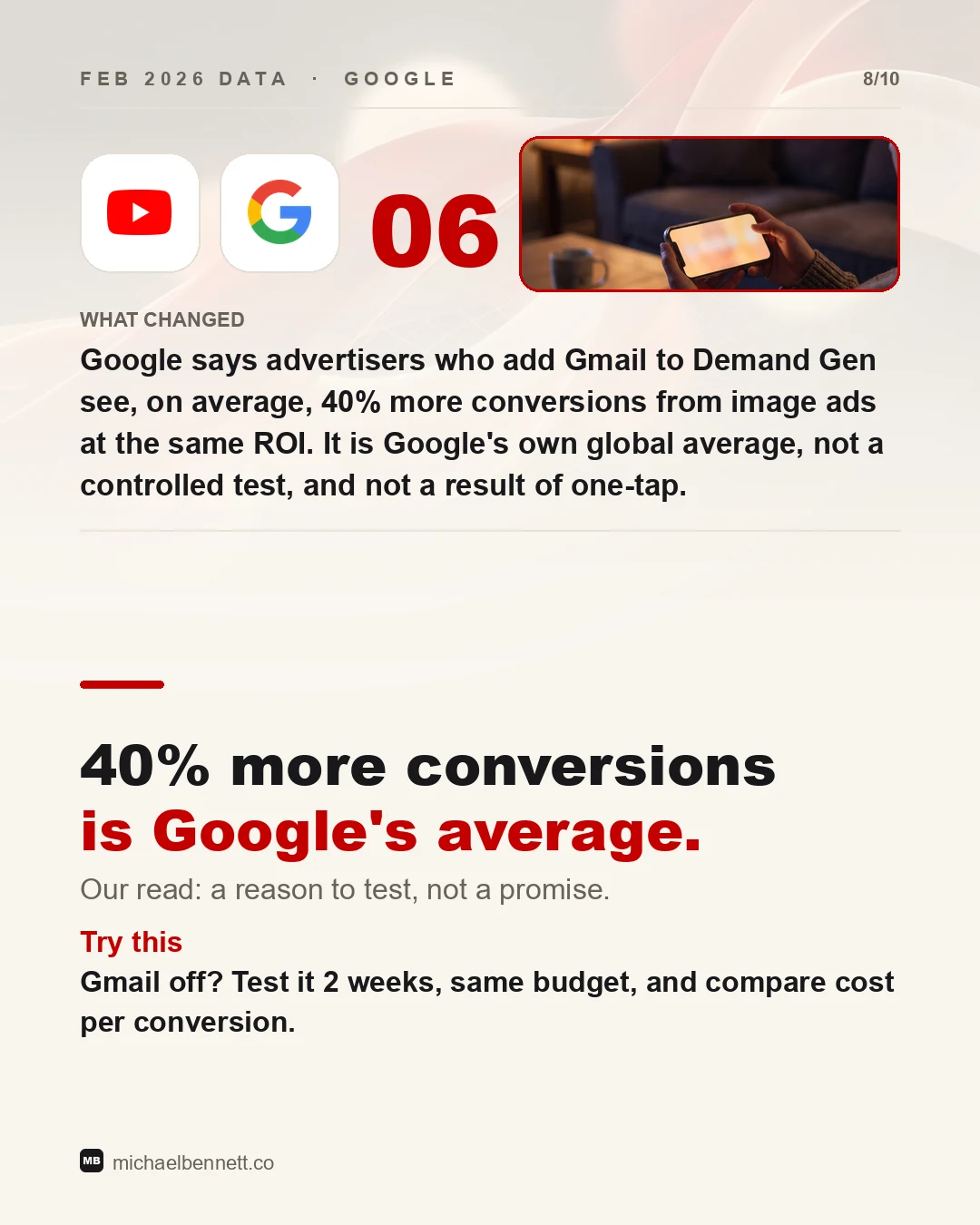
6. 40% more conversions is Google's average
Date and source: February 2026 data, published by Google in the September 24 Drop.
What changed. Google says advertisers who add Gmail to Demand Gen see, on average, 40% more conversions from image ads at the same ROI (return on what you spend). It is Google's own global average, not a controlled test, and not a result of one-tap. Google's footnote: “Google Internal Data, Global, Gmail Ads, February 2026”. Google gives no baseline, sample size or method.
What it means for you. Our read: a reason to test, not a promise.
Try this. Gmail off? Test it 2 weeks, same budget, and compare cost per conversion.
7. Sold through chains? Your ads can be pins
Date and source: September 24, 2026. The Demand Gen Drop and Google Ads help pages.
What changed. Google says “Retail networks and dealerships” can show Demand Gen ads as promoted pins on Google Maps. It is for brands sold in stores they don't own, such as a brand stocked by big chains or a carmaker with dealers. Google gives no launch date. Promoted pins are the square pins you see on the map, and Google's help page adds: “Promoted pins won’t show when zoomed out.” You also cannot run these ads on Maps alone. Asked that question, the help page answers: “No. Chosen campaigns may automatically serve on multiple surfaces.”
What it means for you. Our read: a single shop with its own listing isn't the target. That shop already shows on Maps through its own Business Profile.
Try this. In Location manager, add “Affiliate locations” and pick the chains that stock you. The path in Google Ads is Tools, then Shared library, then Location manager. Google warns that choosing the wrong location type can get these assets disapproved.
Before the holidays: 3 steps
- Fix sizes and ship dates in your product feed. Google's AI answers from your product feed.
- Add a 9:16 image. Gmail off? Test it, same budget. Judge both on your own site visits and cost per conversion, not clicks.
- Chat beta: if you qualify, list 1 campaign ID. Join the beta on purpose, 1 campaign first. Leaving the list empty enrolls every eligible campaign under your manager account.
Fix the feed before the chat.
What the company did not say
That one-tap covers every Gmail ad. Google does not say whether it applies to every Demand Gen image layout, or in every country.
Any result for Business Agent. Google published no conversion, click or engagement number for the AI chat. The other figures in its September 16 post are about product feeds in general and about AI Mode, not this ad.
That it reads your website in YouTube ads. Google says the Search version of Business Agent uses your website. For YouTube ads, it names only product feeds.
That you control what it says. The only controls Google documents for YouTube ads are opting in and choosing which accounts and campaigns are included. Tone of voice, welcome messages and colors are documented for Search only. We found no way to approve answers or read the chats, and no Google screenshot of what the chat looks like.
A date for the Maps pins. Google gives no launch date, no beta label and no list of countries.
That the Drop had 7 announcements. It had 3. Our 7 items are 7 angles on those 3.
That this is Ask YouTube. YouTube announced shopping features for Ask YouTube, its own viewer AI, on September 23, 2026. That is a separate feature, not an ad product.
Sources: verified September 25, 2026 against Google's Demand Gen Drop of September 24, 2026, “Turn discovery into action with September’s Demand Gen Drop”; Google's holiday shopping post of September 16, 2026, by Ashish Gupta; the Business Agent for YouTube Ads beta sign-up form and its terms; Google's help pages on Business Agent, Gmail ad clicks, Shorts ads, ads in Google Maps and location assets; and YouTube's post of September 23, 2026. Quotations are exact. Lines marked Our read are MichaelBennett.co's reasoning, not Google's. Every source, with its URL, is listed in SOURCES.md.
Working out where AI actually fits in your marketing?
I write these while building the systems behind them: measurement, creative pipelines, and agents that do real work. Connect on LinkedIn and tell me what you are working on. That is where these conversations start.
Connect on LinkedIn