
A new AI model launched on 15 September 2026 that cannot write a single word. Not a sentence, not a headline, not a line of code. Its makers call that the point, and for marketing teams, who spend more of their day deciding than producing, they may be right.
The model is called Jev, from a company called TypeSafe AI. Its founder, Diogo Almeida, worked at OpenAI, where in his own words he “helped build the methods that made language models useful at following instructions and talking with people. That work ended up as the research behind ChatGPT.” Jev is what he built next. He told Forbes, as quoted by The Rundown: “Most intelligence should eventually live inside software, running quietly in the background.”
What it does instead of writing
TypeSafe describes Jev as:
“a new class of frontier models built to make fast, structured decisions that software can use directly.”
The mechanism is simple to state. You hand the model a piece of text and one or more questions, and for each question you define the allowed answers in advance. The model returns one of those answers, with a probability attached. It does not compose anything. In TypeSafe's words:
“While Jev gives up string generation, it’s optimized for structured outputs and can’t hallucinate.”
That last claim needs reading carefully. It does not mean the model is never wrong. It means the answer is always one of the options you defined, never an invented fact, never a malformed response your software has to parse and check. TechCrunch put it the same way: “because users define the outputs in advance, it cannot hallucinate.” A confident wrong answer is still possible. That is what the probability is for, and we will come back to it.
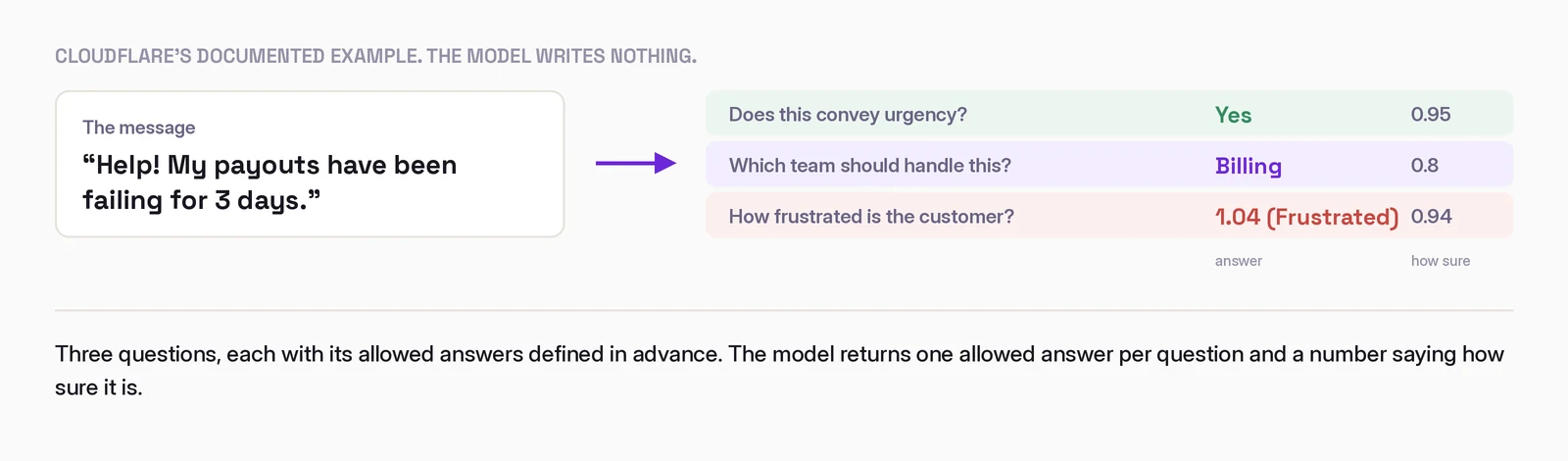
Cloudflare, whose AI documentation carries the model, describes three kinds of question. Jev “evaluates one state against typed Noul, Choice, and Score questions and returns calibrated answers with probabilities and confidence.” In plain terms: a yes or no question, a pick from a list, or a score on a scale. Cloudflare's worked example is a single customer message, “Help! My payouts have been failing for 3 days.”, and three questions about it: “Does this convey urgency?”, “Which team should handle this?”, and “How frustrated is the customer?” One call, three answers, each with a number saying how sure it is. In the documented response, urgency comes back yes at 0.95, the team comes back billing with a confidence of 0.8, and frustration scores 1.04 on a 0 to 2 scale, where 1 is Frustrated, with a confidence of 0.94.
Why marketing should care
The launch coverage treats Jev as a developer story, and the customers quoted are software companies. But look at TypeSafe's own list of what the model is for:
“classify, route, score, extract, or branch where hand-written logic is too brittle.”
That is a description of a marketing operations job. Which inbound lead is worth a call. Which of two hundred ad variations breaks a brand rule. Which customer review needs a human before it is published. Which offer this visitor should see on this page. Every one of those is a decision made hundreds of times a day, and every one of them is made either by a person, by a rule someone wrote in a spreadsheet, or by asking a model built for writing essays and paying that model's price.
Marketing's bottleneck was never producing things. Writing tools have made producing nearly free. The bottleneck is judgment at volume, and judgment at volume is exactly the shape of problem Jev is built for.
The confidence figure is the part to build around
TypeSafe's case for the figure is one sentence:
“If a model can do a task 95% of the time but doesn’t say when it’s in the 5%, it can’t automate that task.”
Jev's answer comes with a probability that the company says is calibrated, meaning “higher confidence means higher accuracy.” Its homepage says what that lets your software do, in one sentence:
“Every Jev decision comes with a confidence estimate, so your software can act when confidence is high and escalate when it is not.”
The Rundown summarized TypeSafe's recommended policy as “automatic action for clear cases, confirmation or more information when confidence drops, and escalation for uncertain cases.” For a marketing team that is a rule you can write on a whiteboard. Approve above a line you choose. Send a person the rest. Move the line as you learn to trust it.
One customer quoted by TechCrunch, who tested the model against Gemini on classifying business emails, said of the confidence score: “it is the only one that hands back a real probability”.
The numbers, and whose numbers they are
TypeSafe publishes its own figures. The two that matter for anyone putting this in a marketing budget are speed and price.
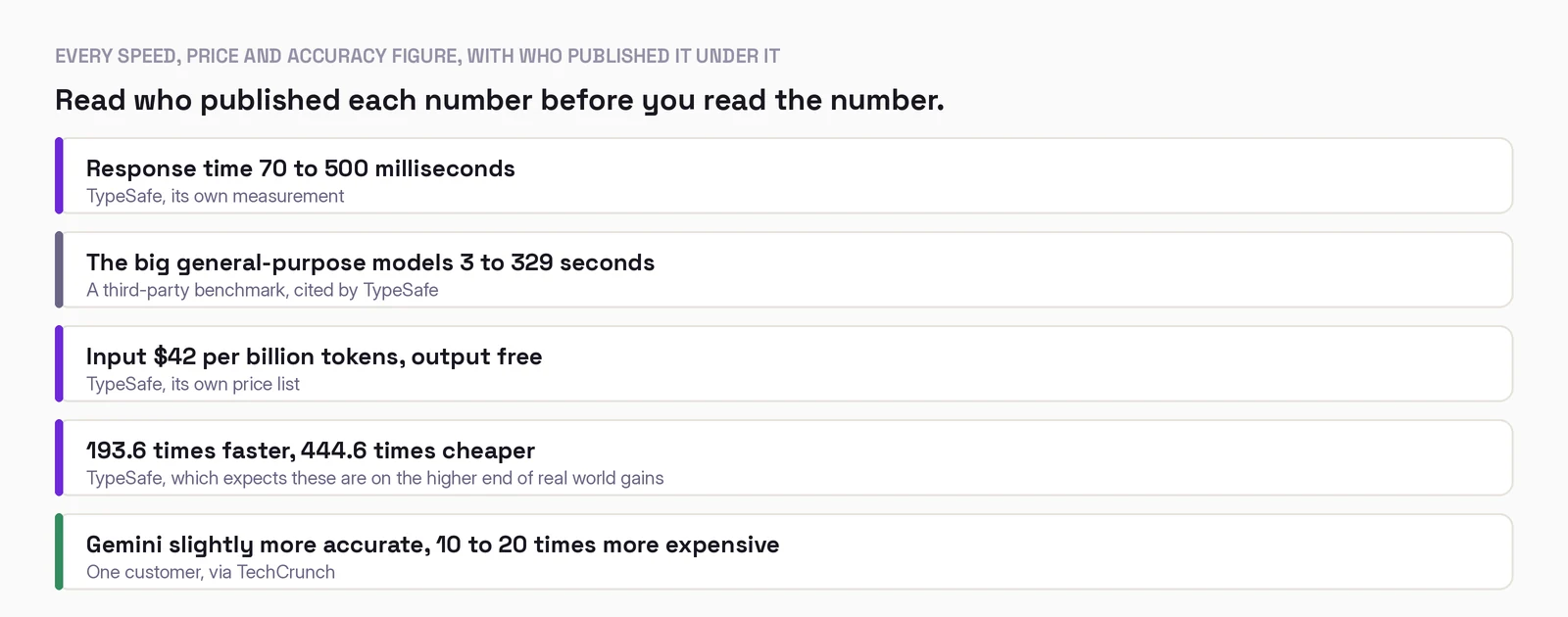
“End-to-end response time is 70ms-500ms for TypeSafe.”
The figure it compares that with, “3 to 329 seconds” for the big general-purpose models, is a third-party benchmark TypeSafe cites, not one it measured. On price:
“Input tokens: $0.042 / MTok ($42 per billion tokens).”
“Output tokens: FREE (too cheap to meter).”
TypeSafe puts input pricing for the big general-purpose models at “from $0.20 to $10 / MTok.” Its homepage headline is “193.6x Faster, 444.6x Cheaper.”
Now the part that has to travel with every one of those numbers. They all come from the company. The reference it measures against is other models it chose: “We use the average of GPT-6 Astra and Fable 5.1 as the reference answer, which biases answers towards OpenAI and Anthropic’s models.” And of the headline figure the company itself says, “we expect that these are on the higher end of real world gains.” On price it is equally direct: “We can’t prove it isn’t subsidized;”.
The only speed, price or accuracy figure in this article that does not come through TypeSafe is the one from the customer TechCrunch quoted, and it cuts both ways. In that email classification test, “Gemini was slightly more accurate, but 10 to 20 times more expensive.” Jev's claim is not that it is smarter. TypeSafe itself claims only “similar levels of intelligence” to the big general-purpose models on the kind of decisions it is built for. The claim is speed, cost and a calibrated probability.
Where I would try it first
LinkedIn has written down five things that make an ad feel low value, the first of which is “Uses generic claims that could apply to any business.” Those five lines are already written as judgments. Turn each into a yes or no question, define the criteria, and run every ad through them before it ships. LinkedIn's own list becomes a checkpoint that, at TypeSafe's quoted price and speed, would cost a fraction of a cent per ad and return in under a second. That is the smallest, most concrete version of the idea, and it asks nothing new of the people who make the ads.
The same shape applies to lead routing, review moderation, and on-site offers. In each case the question is not whether a model can do this, but whether it can do this hundreds of times a day, cheaply, and tell you when it is unsure.
The caveats, in full
It does not explain itself. heise's report makes the point plainly: the model “does not provide a detailed linguistic explanation for its decisions.” You get an answer and a probability, not a reason. For a routing decision that is fine. For a decision you may have to defend to a customer or a regulator, it is a real limit.
The uncertainty moves to you. Armin Ronacher, CTO of Earendil, told TechCrunch: “At the end of the day, it delegates the hallucination problem a little bit to the user,”. A 60 percent answer is only useful if someone has decided what 60 percent means for that decision.
It is early. The model is in early access. At launch, per TechCrunch, “the company briefly lost the ability to serve users from its API because demand was so high.” It works on text, “not on images (yet…)”, and a single question can offer at most 255 options.
The benchmark is the company's. Every speed and cost figure in this article is TypeSafe's own, or a benchmark it chose to cite, measured against a reference of two rival models it selected, and it says so.
What to do first
Pick one decision your team makes a hundred times a day. Lead routing, ad review, comment moderation. Write it as a question with the allowed answers and the criteria for each. That document is useful even if you never run it through a model.
Decide what confidence means before you see any. Choose the line above which a decision goes through untouched, and who sees everything below it.
Ask TypeSafe for early access at typesafe.ai, with that one decision in hand. It says it wants to hear “which decisions you need to automate, where Jev works, and where it falls short.” A marketing team with a real, bounded decision is exactly what it is asking to hear.
Verified 19 September 2026 against TypeSafe AI's announcement of 15 September 2026, its homepage, Cloudflare's model documentation, LinkedIn's Marketing Solutions help page, and reports in TechCrunch, The Rundown and heise online. Quotations are reproduced exactly. The headline speed and cost figures are TypeSafe's own; the company states its reference is the average of two rival models and that it expects its headline gains to be at the higher end of real-world results. The one customer figure is marked as such.
Working out where AI actually fits in your marketing?
I write these while building the systems behind them: measurement, creative pipelines, and agents that do real work. Connect on LinkedIn and tell me what you are working on. That is where these conversations start.
Connect on LinkedIn