
A shopper asks Google's AI for a gift idea. It suggests one of your products. They tap Buy, enter their card and pay, all inside the chat. They never visit your site. The order still lands in your Shopify admin, but your Google Analytics never sees the sale.
What changed, and who it applies to. Shopify's Help Center now says checkout inside Google AI Mode (the AI answer mode in Google Search) and Gemini (Google's AI assistant) is on by default for eligible stores. Scope first: eligible includes a store based in the US, selling to US customers, with a Google Merchant Center account (the Google account that lists your products in Google Shopping) and your store policies filled in in Shopify. Only US shoppers see this checkout. It is rolling out, so it may not be in your store yet. Stores on Shopify's Agentic plan work the other way: there, Shopify says direct checkout starts off. Checkout inside Google is not new. What is new is the wider, on-by-default rollout for Shopify stores, which trade press reported began in mid-September. Black Friday is November 27, 2026.
Below are the 7 things to know, in the same order as our carousel. Where the reasoning is ours, it says "Our read".
1. It's on by default. You don't opt in.
Date and source: September 2026. Shopify Help Center, "Selling on Google AI Mode and Gemini".
What changed. Shopify: “Purchasing in direct checkouts is activated by default for eligible stores, but you can deactivate direct checkout and have customers complete their purchase on your online store instead.” It is also still arriving. In Shopify's words: “Google AI Mode and Gemini is rolling out to eligible stores through Shopify's agentic storefronts. Direct checkout is also rolling out to Google users and might not yet be available in your store.”
What it means for you. That's why it's worth a look this week.
Try this. Open Sales channels > Agentic in your Shopify admin and see what it says.
2. US stores, US shoppers.
Date and source: September 2026. Shopify Help Center.
What changed. Shopify's first requirement: “Your store must be based in the United States and you must sell to customers in the United States.” You also need a Google Merchant Center account that meets Google's rules, and your Terms of service, Privacy policy, and Return and refund policy filled in under Settings > Policies. On the shopper side: “Google AI Mode and Gemini's direct checkout is displayed only to customers based in the United States.”
What it means for you. Outside the US, direct checkout doesn't apply. Shoppers elsewhere can still find your products, and they are sent to your store to buy.
Try this. Check that your Merchant Center account and store policies are complete. Shopify also asks you to “Keep your product data and store policies, including your return and refund policy, up to date so that the information in Google Merchant Center matches your online store.”
3. No extra fee. The order is yours.
Date and source: September 2026. Shopify Help Center, including its "Shopify agentic storefronts" page.
What changed. Shopify: “There are no fees associated with selling in Google AI Mode and Gemini's direct checkout. You pay only your standard payment processing fees.” The order comes to you: “Orders from AI channels display in your Shopify admin with channel or referrer attribution so that you know where the order originated from.” And Shopify says that “For orders that are placed through AI channels, you retain full ownership of the customer relationship and post-purchase experience.”
What it means for you. You keep the customer and the order, like any other sale.
Try this. Filter your Shopify orders by channel to spot the first ones.
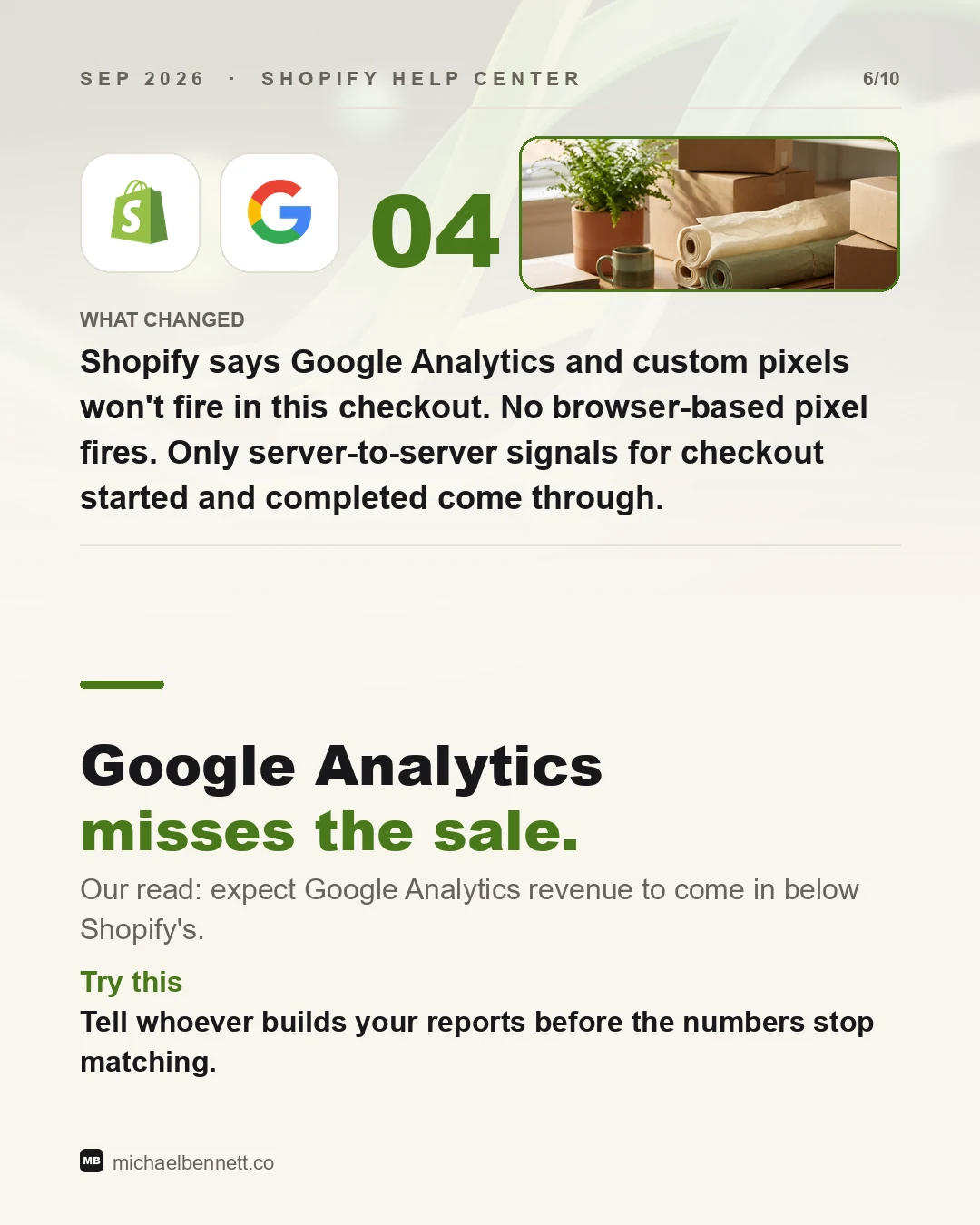
4. Google Analytics misses the sale.
Date and source: September 2026. Shopify Help Center.
What changed. A pixel is a small piece of tracking code that runs in the shopper's browser and reports visits and sales to tools like Google Analytics. Shopify: “Google Analytics and custom pixels won't fire in Google AI Mode and Gemini's direct checkout. The checkout fires only server-to-server pixels (started, completed), so none of the standard or custom client side pixels fire.” Server-to-server means signals sent between computer systems, not from the shopper's browser. Only 2 signals come through that way: checkout started and checkout completed.
What it means for you. Our read: expect Google Analytics revenue to come in below Shopify's.
Try this. Tell whoever builds your reports before the numbers stop matching.
5. Some checkout extras may not show.
Date and source: September 2026. Shopify Help Center.
What changed. Shopify: “Some checkout blocks, such as those for custom fields, upsells, or specific validations, might not display in Google AI Mode and Gemini's direct checkout.” Its list of blocks that might not load includes loyalty and rewards, consent requests, and “Informational-only blocks, for example, trust badges, reviews, or terms or disclaimer text.” The sale still goes through: “Your customer can still complete the checkout, but the on-screen checkout experience might display differently than your online store checkout.” This is only inside Google's checkout. Your own store's checkout is unchanged.
What it means for you. Our read: a buyer there may skip the add-on you count on.
Try this. List the checkout extras your store depends on.
6. Not every product can sell there.
Date and source: September 2026. Shopify Help Center.
What changed. Shopify: “The following types of products aren't supported in Google AI Mode and Gemini's direct checkout:” subscriptions, product bundles, customizable products and B2B-only products. The same list of unsupported features adds delivery: “Local delivery, pickup in store, and pickup points aren't supported as delivery methods in Google AI Mode and Gemini's direct checkout.”
What it means for you. Our read: shoppers can't buy those in the chat, whatever your setting.
Try this. Check which of your best sellers fall into these 4 groups.
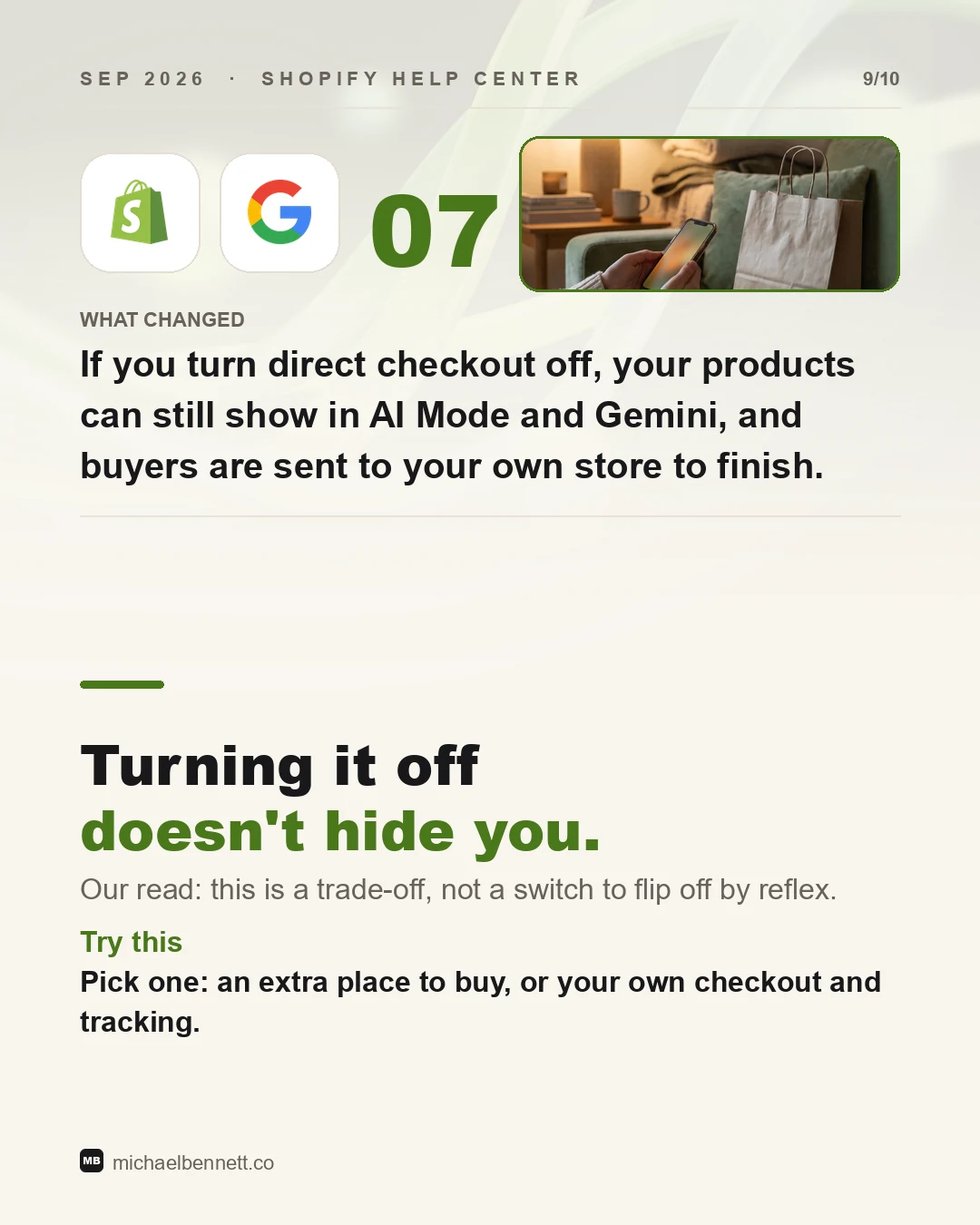
7. Turning it off doesn't hide you.
Date and source: September 2026. Shopify Help Center.
What changed. Shopify: “If you deactivate direct checkout for Google AI Mode and Gemini, then customers using Google AI Mode and Gemini can still discover your products, but they're redirected to your online store to complete their purchase.”
What it means for you. Our read: this is a trade-off, not a switch to flip off by reflex. Off, you keep your own checkout and tracking, but a shopper in the chat has one more step before paying, which may cost you some of those sales.
Try this. Pick one: an extra place to buy, or your own checkout and tracking.
Before Black Friday: decide it on purpose, not by default
Shopify's steps, in its order:
- In your Shopify admin, go to Sales channels > Agentic and turn off Allow Shopify to manage for me.
- Click Google AI Mode and Gemini, set Direct checkout on or off, then click Save.
- If you keep it on, warn whoever builds your reports that these sales will show in Shopify but not in Google Analytics. If you turn it off, your products still show in AI Mode, and buyers finish on your store.
Our read: Shopify's page does not say what else the first switch controls, so look at the other channels on that screen before you click Save. You can change the setting again later.
One more place to buy, against weaker tracking. Keep it on or turn it off: your call.
What the company did not say
That Google switched it on without asking. Shopify lists agreeing to its Agentic Storefronts Supplemental Terms of Service as a requirement. A Google email to merchants saying “Eligible products are automatically included. There's nothing for you to set up.” is known only through Search Engine Roundtable's report of September 22, 2026, and screenshots on X. We found no Google page for it.
When the rollout started. Search Engine Roundtable reported on September 22, 2026 that checkout built on UCP (Universal Commerce Protocol, the system behind checkout inside Google) launched in February, and that Google widened it to more retailers on September 18, 2026. That is a report, not an announcement.
That this checkout is brand new. Google, on September 16, 2026: “UCP already enables direct checkout for hundreds of thousands of brands and retailers across Google.” The news for Shopify stores is the default.
Whether Meta and Microsoft Copilot work the same way. Shopify lists both as AI channels with direct checkout, and its changelog says “Your products are shared with Meta by default through Shopify Catalog.” We could not verify whether direct checkout on those channels is also on by default.
How many shoppers buy this way. Neither Shopify nor Google has published a figure.
Which ad platforms lose their tracking. Shopify says standard and custom browser pixels don't fire. It names no ad platform, so we don't either.
Sources
- Shopify Help Center, "Selling on Google AI Mode and Gemini": https://help.shopify.com/en/manual/online-sales-channels/agentic-storefronts/google
- Shopify Help Center, "Shopify agentic storefronts": https://help.shopify.com/en/manual/online-sales-channels/agentic-storefronts
- Google, "Boost your holiday sales with these agentic commerce updates", September 16, 2026: https://blog.google/products-and-platforms/products/shopping/google-shopping-updates-holiday-shopping/
- Shopify Changelog, "Meta is now an AI channel in your admin", September 8, 2026: https://changelog.shopify.com/posts/meta-is-now-an-ai-channel-in-your-admin
- Search Engine Roundtable, Barry Schwartz, September 22, 2026 (a report, not Google's announcement): https://www.seroundtable.com/google-native-checkout-emails-42140.html
Verified September 25, 2026. Quotations are exact. Lines marked Our read are MichaelBennett.co's reasoning, not Shopify's or Google's.
Working out where AI actually fits in your marketing?
I write these while building the systems behind them: measurement, creative pipelines, and agents that do real work. Connect on LinkedIn and tell me what you are working on. That is where these conversations start.
Connect on LinkedIn