
On September 16, 2026, OpenAI announced that it is testing a kind of ad where the click does not open the advertiser's website. It opens a conversation. The format is called Sponsored Agents, it runs inside ChatGPT, and for anyone who buys paid media it quietly questions an assumption that sits under most of the numbers on the dashboard: that a paid click produces a visit to a page you own.
This is a test, not a launch, and most of what a marketer would want to know about it has not been published. Both of those facts belong in the first paragraph, because the coverage will lose them.
What OpenAI actually announced
The announcement is a single post, "Reimagining advertising with AI." The sentence that matters:
“We’re testing Sponsored Agents, which let people start a conversation with a business-sponsored agent after clicking an ad in ChatGPT.”
OpenAI describes the experience from the user's side. “After seeing a relevant ad, a user can choose to start a clearly labeled conversation with a business-sponsored agent in ChatGPT.” Its example is ordinary on purpose: a shopper “might be curious about a dining table they see in an ad but have questions about whether it fits their space, how many people it seats, or how to care for its finish.” The sponsored agent answers those questions. Then, in OpenAI's words:
“The user can explain what matters to them, ask follow-up questions, and follow a link to the business’s website when they’re ready to take the next step.”
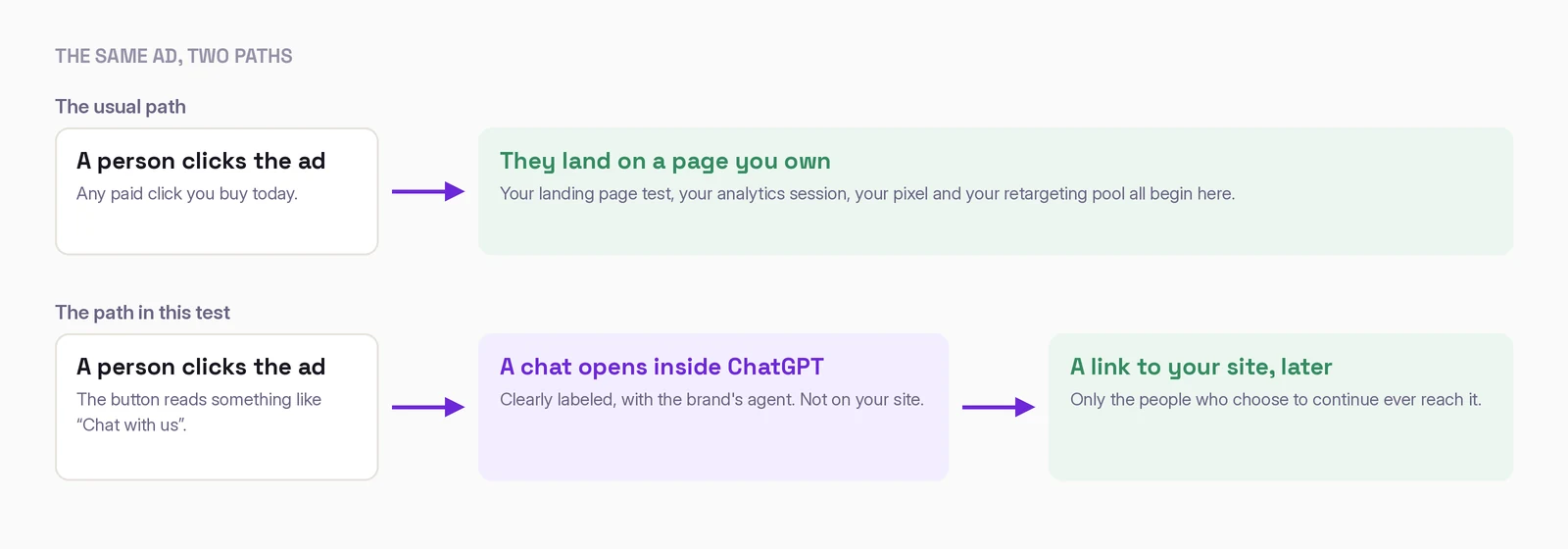
Digiday reported the format two days before the announcement, after seeing it on video and verifying it. Its description of the mechanics is the clearest one available: the ad's button will carry a message such as “Chat with us”, and people who click it “are taken to a branded chat within ChatGPT, where they can interact with the brand’s AI agent.” Its summary is one line: “OpenAI wants ads in ChatGPT to open a conversation with a brand, not a browser tab.”
OpenAI also draws a line around the conversation: “The conversation with a Sponsored Agent is distinct from ChatGPT’s independent answers and separate from the original conversation that the user started in ChatGPT.” The sponsored chat is labeled, and it is its own thread.
Why this touches your numbers
What follows is my reasoning, not anything OpenAI or Digiday said.
Most of what a marketer measures in paid media starts at the visit. The landing page test assumes the click arrives on the landing page. The retargeting pool is built from people who arrived. The analytics session begins when the page loads, and the pixel fires when it does. Cost per click is worth something because a click has meant a person standing on your property, where you can see what they do next.
In this format the click produces a conversation on someone else's property. The visit becomes a later, optional step, taken by the people who choose to continue. Three things follow.
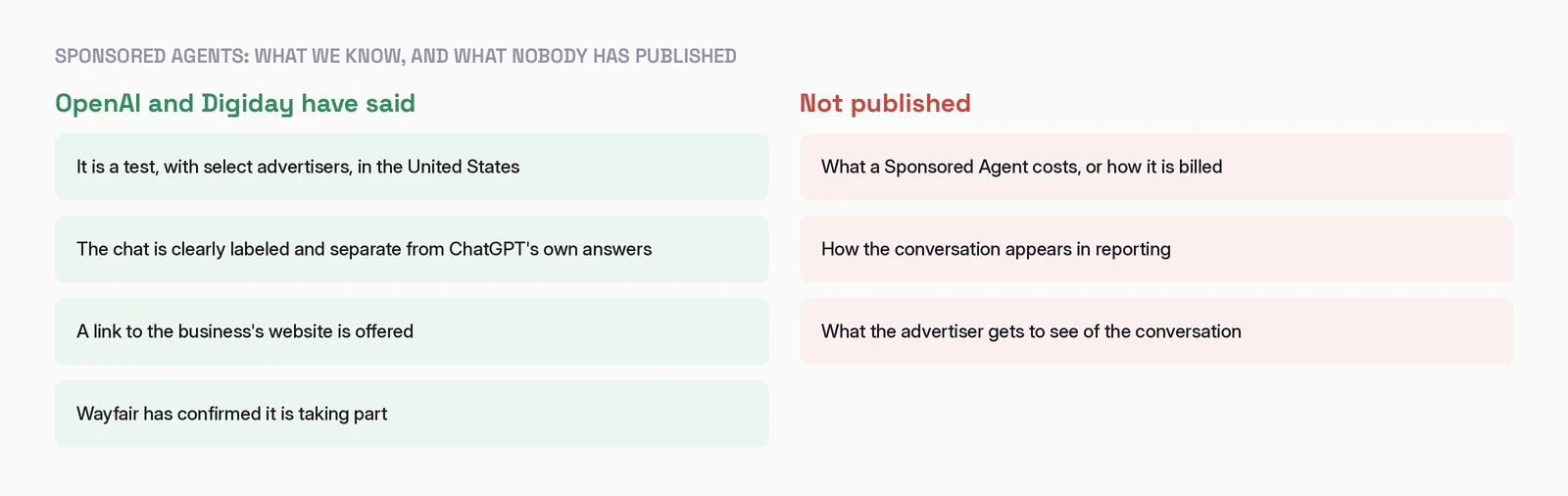
The questions get asked somewhere you may not be able to see. The questions a shopper asks before buying are the questions your landing page exists to answer. In a sponsored chat they are asked and answered inside ChatGPT. Whether the advertiser gets to read them is something OpenAI has not said.
Your site analytics will only ever see the people who continue. That is not a flaw in the analytics. It is what the format is. A campaign could do its job in the chat and look thin in your own reporting, or the reverse, and with what has been published so far there is no way to tell which.
It is a familiar trade, in a new place. Farhad Divecha, group CEO of Accuracast, made the comparison to Digiday directly: “This is similar to Meta Ads that send people to WhatsApp,” he said. Marketers who have run click-to-message campaigns already know the shape of this: the conversation can qualify people well, and it is hard to measure from outside the platform.
Digiday heard the tension put plainly: “Retailers want to get user data through their owned sites, but they know the consumer journey can happen anywhere and they need to vie for those eyeballs and dollars,” said Shamsul Chowdhury, svp paid media at Zeno Group.
What will get reported wrong
That it has launched. OpenAI's sentence is exact: “Sponsored Agents are now being tested with select advertisers in the United States.” A test, select advertisers, one country.
That it replaces your website. It does not. The link to the business's website is part of OpenAI's own description. Your site is still the destination. It is one step further away.
That anyone knows whether it works. One advertiser is on the record. Morgan Brown, director of paid media at Wayfair, told Digiday: “Yes, Wayfair is participating in OpenAI’s Sponsored Agent pilot to explore how conversational commerce can help customers make more informed, confident decisions,” and added, “We’re testing at limited scale with guardrails around product accuracy, transparency and service handoffs.” That last phrase is worth reading twice. An agent that speaks for your brand can be wrong about your product, and the one advertiser on the record put product accuracy first in its list of guardrails.
The wider context is sober too. Chowdhury, on ChatGPT ads so far: “While they’ve been a hot new platform for advertisers, the ROI just hasn’t been there for the most part.” Digiday also notes that “OpenAI did not respond to Digiday’s request for comment.”
What did ship the same day
The same post carried things that are live, and they should not be confused with the test.
“Starting today, businesses managing their customers in HubSpot can connect a ChatGPT Ads account, create ads, track performance, and follow up on leads directly in HubSpot powered by their HubSpot context.” And for stores: “Also available today, US-based Shopify merchants can use the new ChatGPT Ads app in the Shopify App Store to create and manage ChatGPT ad campaigns.” OpenAI adds that “The app will be available internationally in markets where ChatGPT Ads are available starting September 23.”
One more item deserves a marketer's attention because it is opt-in and easy to switch on without thinking: “We’re also launching the ability to opt into AI-powered text customization. If enabled, it adapts an advertiser’s existing headlines and descriptions to better fit the context of a conversation and automatically translates ad copy to a user’s preferred language.” If your ad copy is approved by legal or by a client, decide who is allowed to enable that before someone does.
What to do first
Write down your baseline. Open your analytics and record the last 90 days of visits and conversions that arrive from chatgpt.com. It should take about ten minutes, and it is the number you will want if this format, or something like it, reaches your category.
If you sell on Shopify in the US, decide who owns the ChatGPT Ads app. It is in the Shopify App Store now. Someone on your team can install it today, so decide whether to install it, and who owns it, before anyone does.
Write your questions down now, in case a rep ever pitches it. What does a sponsored conversation cost, and what is billed: the click, the conversation, or the visit that follows? What do we see of the conversation? How does it appear in reporting next to a normal ChatGPT ad? Who is responsible when the agent is wrong about our product? None of these has a public answer yet. A vendor who cannot answer them is asking you to fund the test.
Today a paid click starts on your site. In this test it starts in ChatGPT, and your site comes second. That is a small change in one product, and a useful reason to look at how much of your measurement assumes the visit comes first.
Verified September 21, 2026 against OpenAI's announcement of September 16, 2026, "Reimagining advertising with AI", and Digiday's report of September 14, 2026 by Krystal Scanlon. Quotations are reproduced exactly. OpenAI has not published pricing, billing, reporting or data-sharing details for Sponsored Agents; the consequences for measurement described above are the author's reasoning.
Working out where AI actually fits in your marketing?
I write these while building the systems behind them: measurement, creative pipelines, and agents that do real work. Connect on LinkedIn and tell me what you are working on. That is where these conversations start.
Connect on LinkedIn