
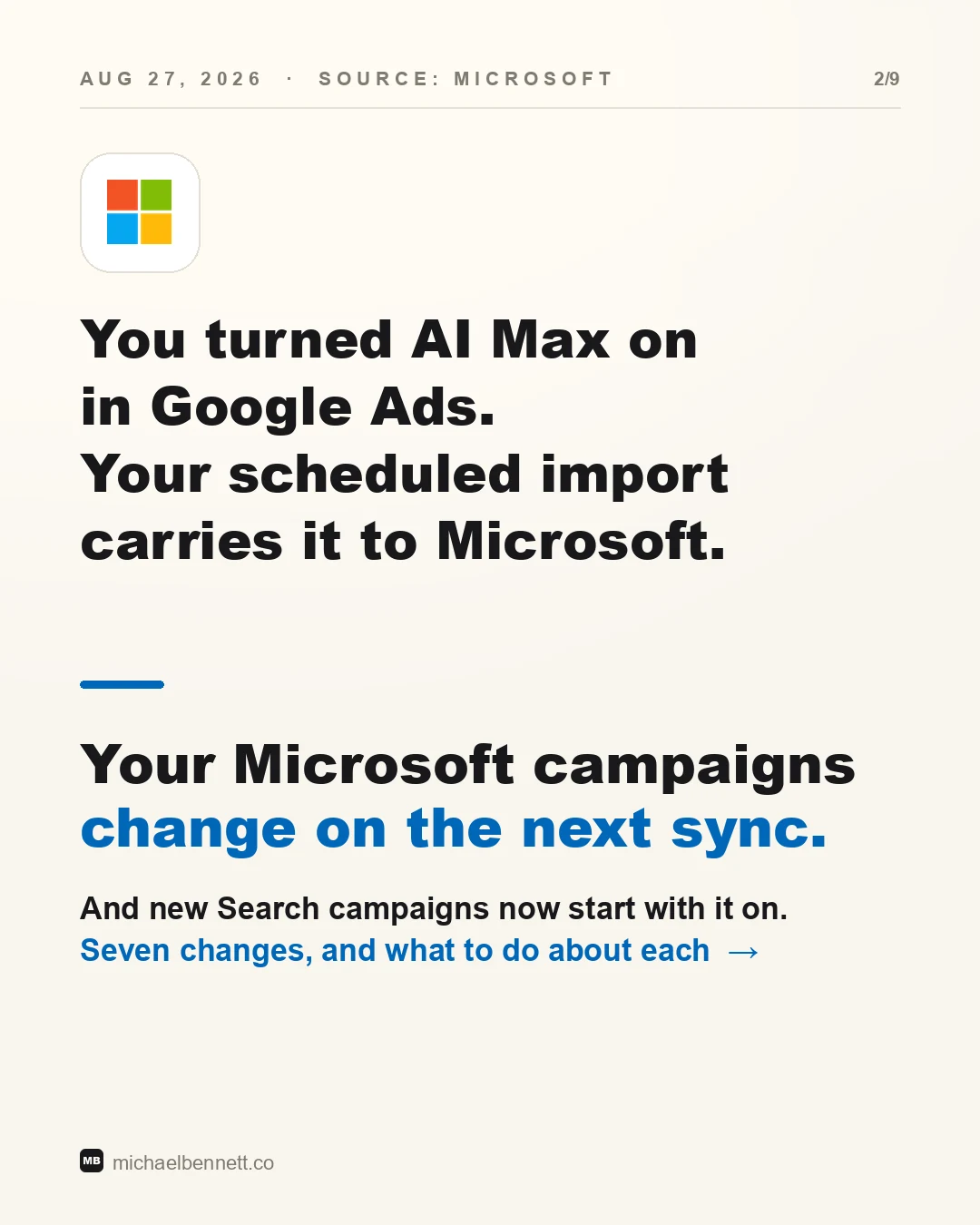
A setting you chose in Google Ads can now change your Microsoft campaigns. Nobody has to open the Microsoft account. It happens if you import your Google campaigns on a schedule.
The setting is AI Max. On August 27, 2026, Microsoft announced it as generally available, and the announcement included this:
“If you're using Google Import, AI Max settings can now be carried over from Google Ads. For accounts using scheduled imports, any Microsoft campaigns that correspond to campaigns with AI Max enabled in Google Ads will continue to inherit those settings during future syncs.”
So if you turned AI Max on in Google Ads, your scheduled import carries it to Microsoft on the next sync. Six more changes follow. One takes effect October 1, and one edit after that date cannot be undone, per Search Engine Land.
1. AI Max is on by default for new Search campaigns
Date: August 27, 2026, from Microsoft's own announcement.
What changed. Microsoft describes the product in one sentence: “AI Max brings Microsoft AI to standard Search campaigns through search term matching, text customization, and final URL expansion.” In plain words, Microsoft can match your ads to queries beyond your keyword list, write extra ad copy, and send the click to a different page on your site than the one you set.
And it starts switched on. Microsoft again: “AI Max will also be enabled by default for any new Search campaigns you create in Microsoft Advertising, though it can still be turned off at any time during campaign creation or afterwards.”
Some trade coverage from August 19 described AI Max as a setting you choose to turn on. Microsoft's post eight days later says the opposite for new Search campaigns. The accurate version: on by default for new Search campaigns, not applied after the fact to campaigns you already had, and it arrives through Google Import. Google has a product with the same name that handled existing campaigns differently, so do not carry what you read about one over to the other.
What it does to your numbers. My read, not Microsoft's statement: three of the things a search advertiser controls (which queries you buy, what the ad says, where the click lands) can now move without anyone on your team editing anything. Expect wider search term reports and landing page conversion rates that shift. Microsoft says AI Max respects your negative keywords, bid strategies, budgets and targeting.
Do this. Check AI Max on every Search campaign built since August 27, and in your Google import. Then decide whether it stays on.
2. Your CPC cap goes away on new campaigns
Date: October 1, 2026. Sources: Microsoft, plus Search Engine Land for the September details.
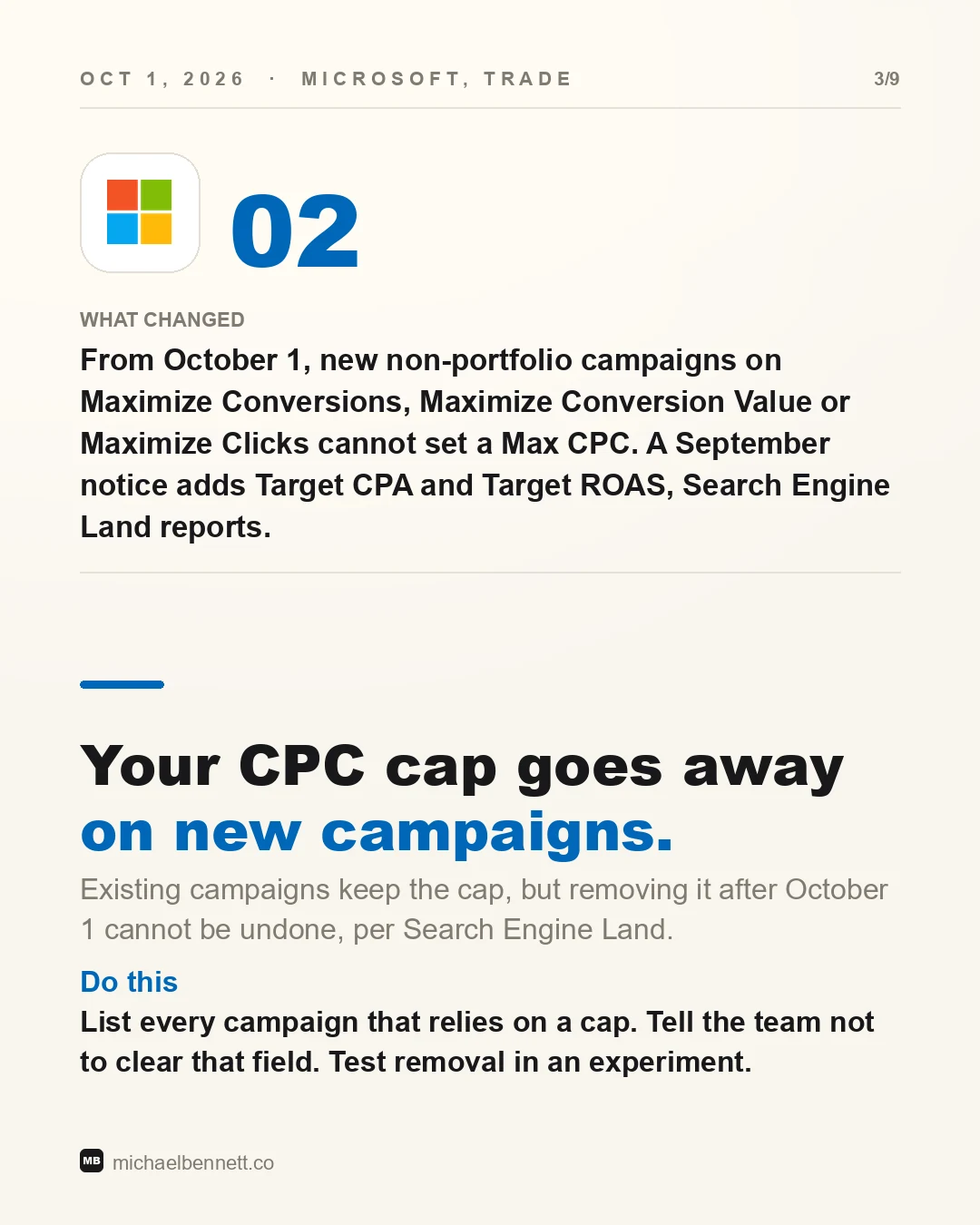
What changed. A Max CPC is the ceiling you set on what a single click can cost. Microsoft's August product roundup says: “starting October 1, the Max CPC setting will no longer be available when creating new non-portfolio campaigns using Maximize Conversions (with Target CPA), Maximize Conversion Value (with Target ROAS), or Maximize Clicks.” A portfolio bid strategy is one strategy shared across several campaigns. Those keep the cap: “Max CPC will remain available for new and existing campaigns using portfolio bid strategies.”
Then the scope grew. Search Engine Land reported on September 8 that a Microsoft notice of September 7 widened it: “Microsoft’s Max CPC restriction will also apply to Target CPA and Target ROAS campaigns, expanding the bid strategies beyond the Maximize Conversions, Maximize Conversion Value and Maximize Clicks strategies reported in August.” I have not seen that notice myself, so treat it as reported. Search Engine Land does not explain how this differs from Microsoft's August wording, which already mentions both targets.
What it does to your numbers. Existing campaigns that already use a cap keep it. The costly detail is in the same Search Engine Land report: “Microsoft now says removing it after that date is irreversible”. Clear that field on an older campaign after October 1 and the cap cannot be put back. My reasoning: a routine edit becomes a permanent account decision.
Microsoft has not said existing campaigns will lose the cap later. It said only that more updates will come.
Do this. List every campaign that relies on a cap. Tell the team, in writing, not to clear that field. Test removal in an experiment, never by editing the live campaign. Per Search Engine Land, there is no way back.
3. Microsoft can add copy to ads you approved
Dates: January 15 and April 16, 2026. Source: Microsoft.
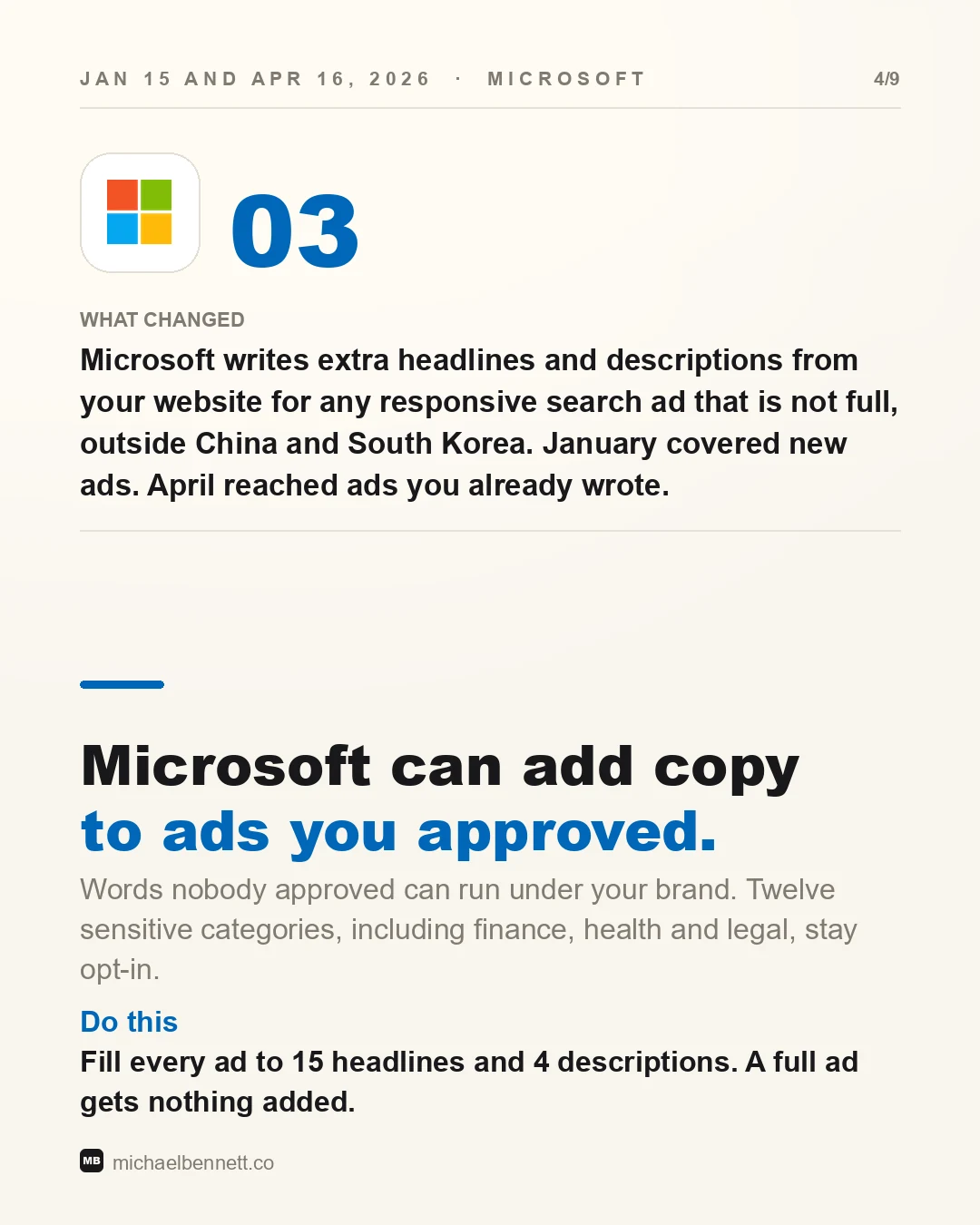
What changed. A responsive search ad holds up to 15 headlines and 4 descriptions, and the platform mixes them. If yours is not full, Microsoft writes extra headlines and descriptions from your website. In January this covered new ads: “Starting today, we begin rolling out Autogenerated assets as an automatically enabled feature when you create new Responsive Search ads (RSA) for users globally, excluding China and South Korea.” In April it reached ads you had already written: “existing Responsive Search ads without the maximum text assets supplied by users”.
What it does to your numbers. Words nobody approved can run under your brand. Twelve sensitive categories, including finance, health and legal, stay opt-in, meaning Microsoft adds nothing there unless you ask.
Do this. Fill every ad to 15 headlines and 4 descriptions. Microsoft: “if you have already provided the maximum text assets, autogenerated assets will not generate any additional assets.” A full ad gets nothing added.
4. Microsoft may now count conversions differently
Date: end of May 2026. Source: Microsoft.
What changed. Data-driven attribution splits the credit for a conversion across the ad touchpoints that came before it, instead of giving all of it to the last click. Microsoft's May roundup: “data-driven attribution is now rolling out to all advertisers by the end of May.”
That sentence says the model became available to everyone. No Microsoft post I have read says it became the default, or that last-click was removed. Hence the "may" in the heading.
What it does to your numbers. My read: if a conversion goal in your account moved to the new model, a comparison that crosses May 2026 can measure two different things. Generic keywords can look better and brand terms worse with no change in the business.
Do this. Check which model each conversion goal uses, and mark any change date on every dashboard that spans it.
5. Performance Max now takes negative keywords
Date: March 17, 2026. Source: Microsoft.
What changed. Performance Max is the campaign type where Microsoft decides placements across its inventory. It now accepts negative keywords, the list of searches you refuse to pay for. Microsoft: “Negative keyword lists can be applied at the campaign or account level, and the limit is 5000 negative keywords per list.” Match types work as they do in Search, and the lists import from Google Ads.
What it does to your numbers. You can stop Performance Max buying your brand terms, job seekers and support queries. The catch, in Microsoft's words: “negative keywords currently only apply to Search and Shopping inventory in PMax.” They do not reach audience or native placements.
Do this. Import your Google negative lists and apply them at account level, so every future campaign inherits them.
6. A tool you rely on may stop in January
Dates: feature freeze October 1, 2026. Switched off January 31, 2027. Source: Microsoft.
What changed. Most bid, feed and reporting tools reach Microsoft through an older connection called the SOAP API. Microsoft is retiring it in favor of a newer one called REST. Microsoft Learn states: “Starting October 1, 2026, all new Microsoft Advertising API features and enhancements will be available only through the REST API.” And from the announcement: “The SOAP API will be fully deprecated on January 31, 2027.”
Nothing breaks on October 1. Existing connections keep running until the January date.
What it does to your numbers. A tool that has not migrated can stop updating bids or uploading conversions on January 31, 2027.
Do this. Email every vendor that touches your account and ask for their REST migration date in writing.
7. You can now see where your Performance Max money went
Dates: January to September 2026. Source: Microsoft.
What changed. Across the year Performance Max gained search term and landing page reports, conversions by website, uplift experiments, and age and gender targeting. On that last one, Microsoft wrote on August 31 that it “will be generally available by next week on September 8.” I have not found confirmation that it landed on that date, so check your own account.
What it does to your numbers. You get reports by search term, landing page and website. The uplift experiment answers the harder question. Microsoft says these experiments “help you measure the conversion or conversion value uplift that Performance Max campaigns can provide when added as a complement to your other campaigns types”. In plain words: did it add conversions, or move them over from Search?
Do this. Run one uplift experiment before you set next year's budget.
What to do this week
Three settings. Check them this week.
- Check AI Max on every Search campaign built since August 27, and in your Google import.
- List the campaigns that depend on a Max CPC cap before October 1.
- Fill every responsive search ad to 15 headlines and 4 descriptions.
Several of these changes arrived switched on. A default is not a decision you made.
Sources: verified September 21, 2026 against Microsoft Advertising's 2026 product posts, its AI Max announcement of August 27, 2026, its API announcement and the Microsoft Learn REST migration page. The September widening of the Max CPC change, and the point that removal cannot be undone, come from one trade source, Search Engine Land, reporting a Microsoft notice of September 7 that I could not open directly. Quotations are exact. Lines marked my read or my reasoning are mine.
Working out where AI actually fits in your marketing?
I write these while building the systems behind them: measurement, creative pipelines, and agents that do real work. Connect on LinkedIn and tell me what you are working on. That is where these conversations start.
Connect on LinkedIn