
Meta published holiday guidance this month advising advertisers to supply more creative formats so Advantage+ can select the winning combination. Sensible advice, and Meta has the data to support it.
There is a mechanism underneath that advice that the article does not mention.
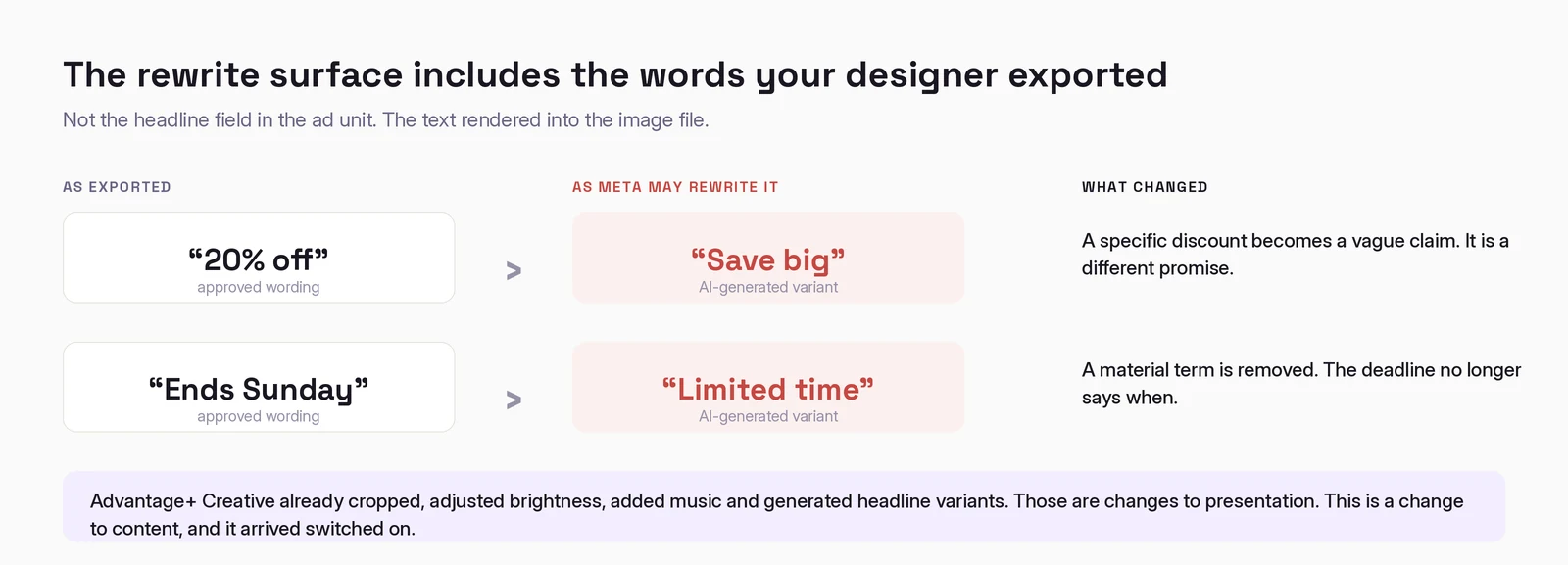
Since late July 2026, Advantage+ Creative can rewrite the text baked into your ad images. Not the headline field in the ad unit. The words rendered into the image file your designer exported. It generates variants with AI-written copy while preserving the original layout and design.
It is enabled by default on eligible Advantage+ campaigns.
Jon Loomer documented the feature on 28 July. Common Thread Collective confirmed the default-on status. This is not a rumor and not an opt-in beta.
Why this one is different
Advertisers have been ceding creative control to Meta for years, and mostly it has been fine. Advantage+ Creative already crops images, adjusts brightness, adds music, applies templates and generates headline variants for the text fields.
Those are all changes to presentation. This is a change to content, and it targets the one element most advertisers assume is immutable.
The words inside an image feel fixed in a way an ad copy field does not. They went through a design process. Somebody chose that phrasing, someone else approved it, and it was exported into a file. The mental model most teams hold is that the image is the artifact and everything around it is configuration.
That model is now wrong, and the setting that made it wrong arrived switched on.

Who should care, specifically
For a lot of advertisers this is genuinely upside. If your image text reads "Shop the sale" or "New season in", having Meta generate and test a dozen variants is free performance you were not going to get manually.
The problem is concentrated, and it is severe where it lands:
Regulated industries. Financial services, health, insurance, legal. Claim wording is approved, not chosen. An AI-generated variant of an approved claim is an unapproved claim, regardless of how reasonable it sounds.
Pricing and offers rendered into creative. "20% off" becoming "Save big" is a different promise. "Ends Sunday" becoming "Limited time" removes a material term.
Disclaimers inside the image. If the legal line is part of the artwork rather than the caption, it is inside the rewrite surface.
Brands with a defined voice. Not a compliance risk, a positioning one. Voice is cumulative; it is built by consistency, and consistency is exactly what variant generation optimizes away.
The default is the real issue
It is worth being precise about the objection, because "Meta bad, AI bad" is not it.
Automated creative testing works. Meta has enormous evidence that generating variants improves outcomes across their advertiser base in aggregate. Shipping the feature is defensible.
The issue is that the default assumes your image text is a suggestion, and for a meaningful minority of advertisers it is a commitment. Defaults are policy. They determine what happens to the majority who never open the settings panel, and a default that is right for most accounts can still be seriously wrong for a specific one.
The asymmetry matters too. If it is on and should be off, you may not find out until a compliance review or a customer complaint. If it is off and should be on, you lose some incremental performance you can recover next quarter.
What to actually do
Open your Advantage+ Creative settings and read them. Not what you remember configuring. What is enabled right now, today, on the campaigns about to carry your Q4 budget. Settings that arrive default-on do not announce themselves.
Decide per account, not globally. A DTC apparel brand and a regulated lender should not have the same answer here. If you manage multiple accounts, this is a per-client decision and probably a per-client conversation.
If you turn it off, write down why. Someone will find it disabled in six months, see performance guidance recommending it, and switch it back on without knowing the reason.
If you leave it on, exclude the creative that cannot tolerate it. This is not all or nothing at the account level.
The broader pattern
This is the third time this year a major platform has expanded automation scope through a default rather than a launch.
That is not deception, the features are documented, and trade press covers them. But documentation is pull and defaults are push, and the gap between those two is where most advertisers actually live.
Meta's holiday guidance is right that creative volume wins. The question worth asking before Q4 is simply whose creative is being volumized.
Working out where AI actually fits in your marketing?
I write these while building the systems behind them: measurement, creative pipelines, and agents that do real work. Connect on LinkedIn and tell me what you are working on. That is where these conversations start.
Connect on LinkedIn