
If your Meta reports showed fewer conversions from clicks this spring, check the date before you check the campaigns. On March 3, 2026, Meta announced a change to what counts as a click when it gives an ad credit for a sale, and it started rolling out later that month. A like, a share or a save used to count. Now only a link click does.
Meta's sentence: “Going forward, we are changing the definition of click-through attribution for website and in-store conversions to exclusively include link clicks.”
Your reports changed. Your sales did not, and neither did your bill. That is the pattern in most of these seven changes from 2026: they moved a number you look at, not a result you earned. Each one below has its date, what changed, what it does to your numbers and one thing to do. Where the reasoning is mine and not Meta's, I say so.
1. A like, a share or a save no longer gets click credit (announced March 3, 2026)
What changed. Attribution is the rule Meta uses to decide which ad gets credit for a sale. The new definition covers campaigns aimed at website or in-store conversions. The sales that used to be credited to those other actions were not deleted. Meta moved them: “That’s why we are shifting conversions that came from a share, save, or other non-link click actions to be included in engaged-view attribution.” It renamed that group in the same post: “going forward, it will be known as engage-through attribution.” For video ads, an engaged view now takes 5 seconds of watching, down from 10.
The rollout was staged. Meta said on March 3 that the changes “will begin later this month” and that “advertisers may see these changes take effect at different points”. It gave no completion date.
What it does to your numbers. Conversions reported as click-through can drop, and engage-through conversions rise, with no change in what customers did. Meta published no figure for how large the move is, so I will not give one. On cost it is plain: “There will be no change to how advertisers are billed.”
My read, not Meta's statement: any before and after comparison that crosses March 2026 misleads you unless you split it by attribution setting.
What to do. In Ads Manager, use Compare attribution settings across February to May for the same campaigns, with click-through and engage-through in separate columns. Then pick, in writing, the number your team manages to.
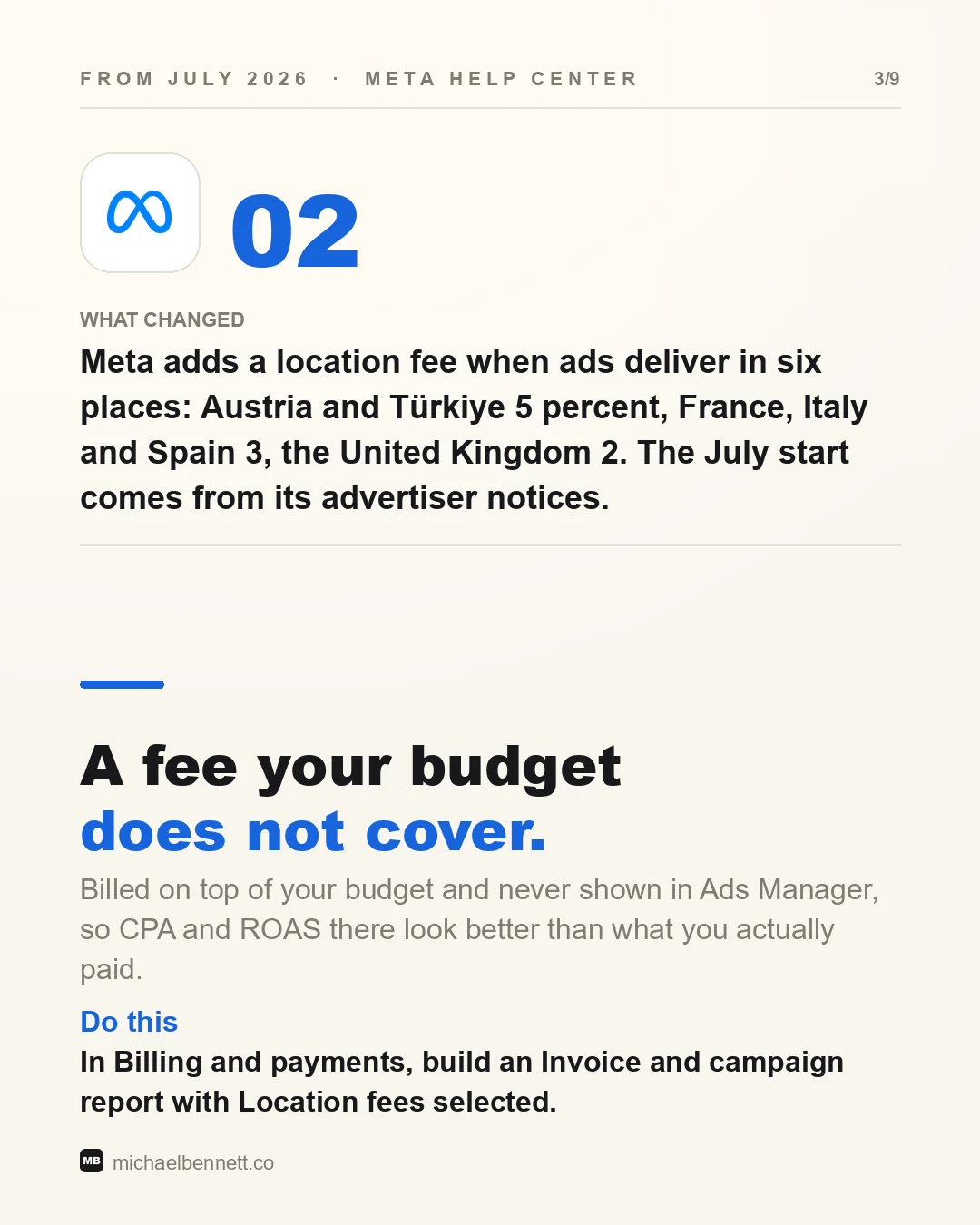
2. A fee your budget does not cover (from July 2026)
What changed. Meta now adds a location fee when your ads deliver in six places: Austria and Türkiye at 5 percent, France, Italy and Spain at 3 percent, and the United Kingdom at 2 percent. It depends on where the ad is shown, not where you are based. That is six named places, not a fee on Europe. Meta says the list and the rates may change.
Meta's Help Center page carries no start date. The July 2026 start comes from Meta's notices to advertisers, as reproduced in trade coverage.
What it does to your numbers. The fee is billed on top of your budget. Meta: “This fee is separate from your campaign budget and will appear as a distinct line item on your invoice or transaction statement.” And: “Location fees will not appear in Ads Manager reporting metrics.” So cost per acquisition and return on ad spend in Ads Manager look better than what you paid. It also says: “Meta will not issue refunds for location fees based on legitimate ad impressions.”
What to do. In Billing and payments, build an Invoice and campaign report with Location fees selected. Compare one month of it with the same month's spend in Ads Manager.
3. Old Advantage+ campaigns are being switched off (February 18 and May 19, 2026)
What changed. Meta is retiring the old Advantage+ Shopping and Advantage+ App campaign types in favor of one Advantage+ setup on a normal Sales, App or Leads campaign. What Meta has documented is a change to its Marketing API, the connection that agency and reporting tools use to build and edit campaigns. In its developer post, where ASC and AAC are the two old types: “From V25.0 (18th February 2026) ASC and AAC campaigns can no longer be created or updated using the Marketing API, this will extend to all MAPI versions after 90 days (by May 19th 2026).”
Remaining ones will be paused, and Meta gave no firm date. Its February post said: “In V26.0 (estimated September 2026) all remaining ASC and AAC campaigns will be paused.” Version 26.0 shipped on July 29, 2026, and its release post does not mention the pause.
What it does to your numbers. A rebuilt campaign gets a new campaign ID. That resets learning, the period when Meta's delivery system is still working out who to show the ad to, and it breaks any report keyed on the old ID.
What to do. Duplicate each old campaign into the new setup and map old IDs to new in your reporting. Keep the old one running until the new one is out of learning. Running both means paying for both for a while, so set the two budgets on purpose.
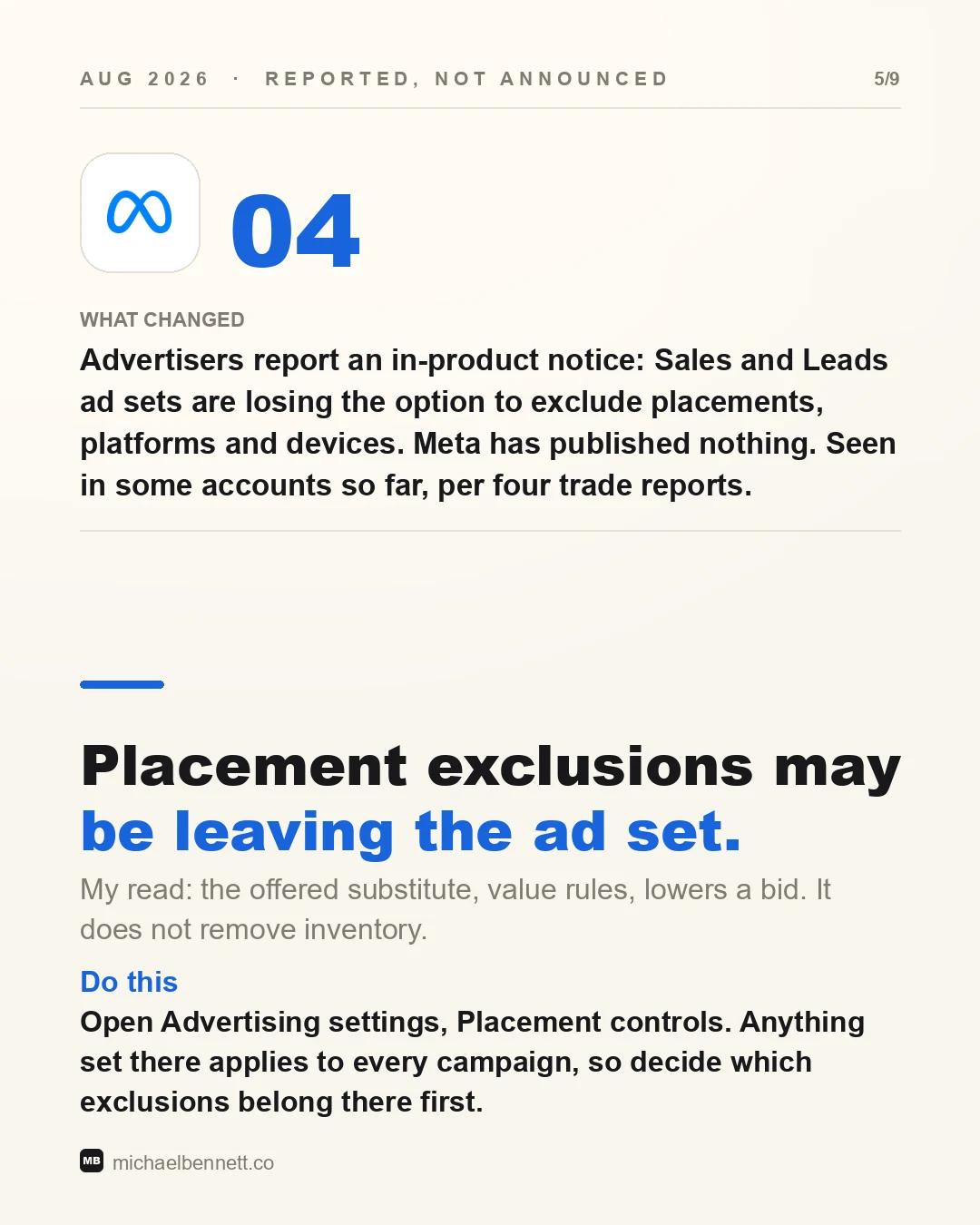
4. Placement exclusions may be leaving the ad set (August 2026, reported, not announced)
What changed. This one is not a Meta announcement. Advertisers report a notice inside Ads Manager saying that Sales and Leads ad sets are losing the option to exclude placements, platforms and devices. As reproduced by Jon Loomer, who first reported it on August 20, 2026, the notice reads: “Excluding placements, platforms, devices and operating systems will no longer be available for your ad sets.” Loomer adds: “It’s not clear when this change will go into effect.”
Meta has published nothing. Four trade reports agree, and so far it has been seen in some accounts only. PPC Land put it this way: “What the post documents is a partial rollout observed in some accounts, not a completed platform-wide change.”
What it does to your numbers. My read: the substitute on offer, value rules, lowers a bid. It does not remove inventory. PPC Land reports the largest cut a value rule allows is 90 percent, so a placement you thought was shut off can still win impressions and take budget.
What to do. Open Advertising settings, then Placement controls. Anything you set there applies to every campaign in the ad account, and that can cut delivery you wanted somewhere else. So decide which exclusions belong at account level before you set any.
5. Meta can rewrite the words on your image (June 28 and July 2026)
What changed. Advantage+ creative is Meta's set of automatic edits to your ads. On June 28, 2026, Meta added new ones through its API. One is Image Animation: “When enabled, a static image in your ad is automatically transformed into a short, subtly animated video” is how Meta describes it. Another, Video Filter, can recolor your video.
Separately, in July, practitioners reported that it also swaps the headline printed on an uploaded image for versions written by AI, while keeping the fonts, colors and layout. Trade sources call that on by default. Meta's developer documents list these features as optional.
What it does to your numbers. Less your numbers than your risk. A price, a claim or a legal line printed on your image can stop matching your landing page.
What to do. Fill in Branding in Ads Manager, above all the Restricted words list. Then look through your ads for headlines you do not recognize. Do not treat the list as a guarantee. Loomer, who tested it: “Or Meta will occasionally include a word that I’ve added to the Restricted Words list.”
6. Your retargeting pools may have grown (announced June 9, 2026)
What changed. Meta retired the setting that let a person disconnect, from their own account, the activity that businesses send Meta from their sites and apps. Meta's timing: “These control and data-use changes will go into effect in the US and a number of other countries next month with more countries to follow.” From a June 9 post, that means July. Meta did not name the other countries, so I will not assume yours is one. It is also clear about what this is not: “We aren’t collecting any new data as part of this update.” A second setting still lets people refuse this personalization.
What it does to your numbers. My reasoning, not Meta's statement: people who used that opt-out can be matched again, so retargeting audiences built from your website can grow without anyone touching them. A sudden jump looks like a targeting mistake. Meta says nothing about audience size.
What to do. Chart your three largest website audiences across June and July. Mark any sudden jump in your reporting before you judge a test that ran across it.
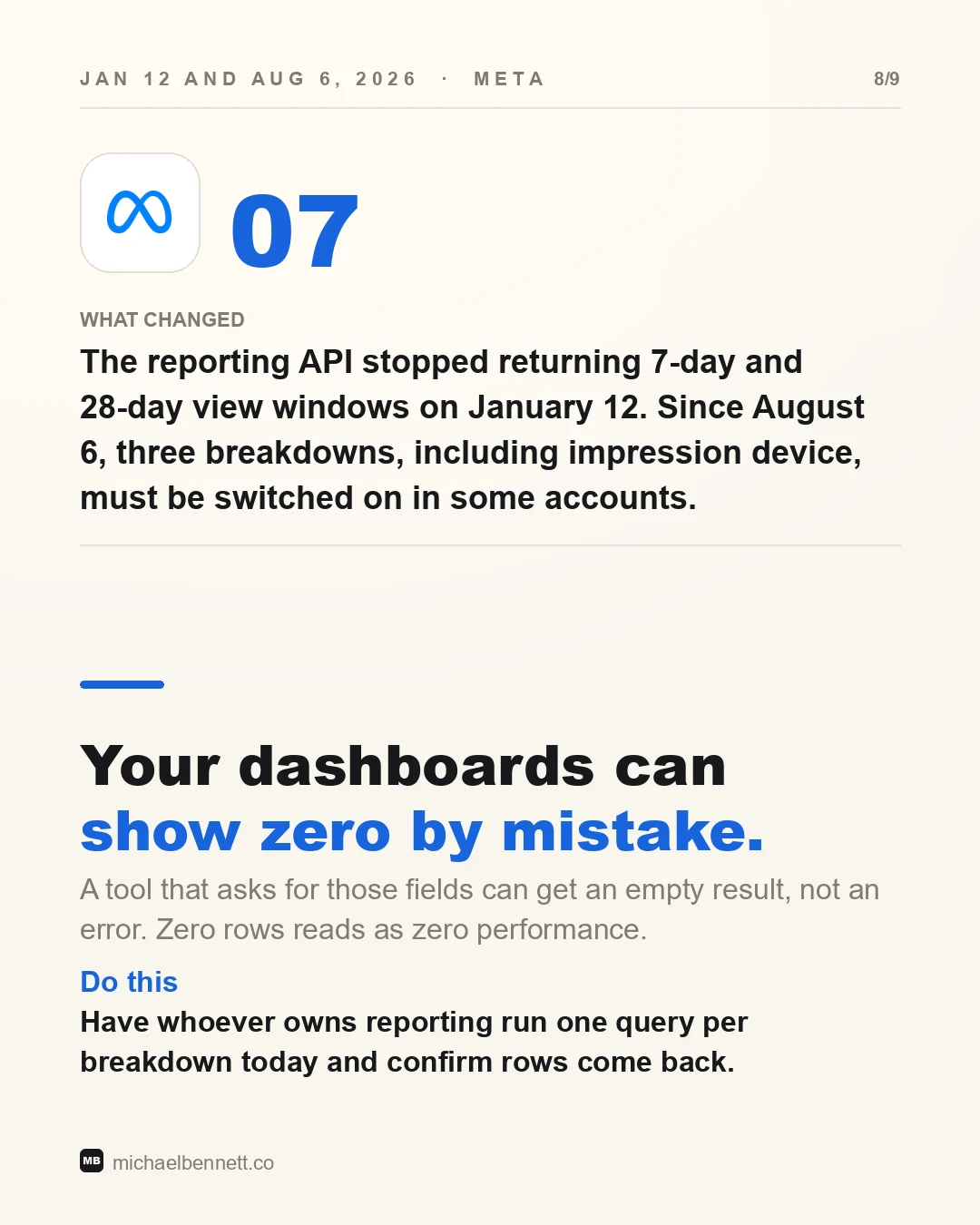
7. Your dashboards can show zero by mistake (January 12 and August 6, 2026)
What changed. On January 12, 2026, Meta's reporting API stopped returning the 7-day and 28-day view windows, a change Meta had announced on October 16, 2025. That is not the end of view-through attribution: the 1-day view window and the click windows remain. Then, since August 6, 2026, three breakdowns, including impression device, must be switched on before the API will return them. Meta says this applies to certain ad accounts and does not define which.
What it does to your numbers. A tool that asks for those fields can get an empty result, not an error. Meta's wording: “API requests using these breakdowns may return no results for Ad Accounts that have not enabled them, whether synchronous or asynchronous.” Zero rows reads as zero performance.
What to do. Have whoever owns reporting run one query per breakdown today and confirm rows come back.
What to do this week
Three checks before the budget meeting.
- Compare attribution settings across February to May, and pick the number you manage to.
- Reconcile one month of invoices against Ads Manager spend for location fees.
- Decide which placement exclusions belong at account level, and fill in Restricted words.
Most of these changed your numbers, not your results. Do not cut a budget over a reporting change.
Sources: compiled September 21, 2026 from Meta's own posts and documentation and, for the two items Meta has not fully documented, trade reporting by Jon Loomer, PPC Land, Marketing Dive and Common Thread Collective. Quotations are reproduced exactly. Lines marked as my read or my reasoning are mine, not Meta's. Every source, with its link, is in this post's SOURCES file.
Working out where AI actually fits in your marketing?
I write these while building the systems behind them: measurement, creative pipelines, and agents that do real work. Connect on LinkedIn and tell me what you are working on. That is where these conversations start.
Connect on LinkedIn