
From September 1, Google begins automatically upgrading Search campaigns to AI Max. If you run campaign-level broad match or automatically created assets, this includes you, and the notice went out by email on August 5.
Most coverage has described this as a single switch flipping on September 1. That is not quite what happens, and the details that get compressed out are the ones that determine what actually changes in your account.
Three of them matter.
It is a month, not a day
The automatic migration runs September 1 through September 30. It is a rolling window, not a moment.
Practically, this means you cannot verify on the morning of September 1 and conclude you were skipped. A campaign untouched in week one may be converted in week three. If you are auditing for this, audit through the end of the month, and diary a check for early October rather than early September.
It also means diagnosis gets harder, not easier. A performance change in mid-September has more candidate explanations than usual, and "was this campaign migrated yet, and when" is now a question you need to be able to answer for any campaign you are investigating. Record the date each campaign converts. You will want it in October.
The defaults differ depending on why you were upgraded
This is the part that is genuinely underreported, and it is the single most useful thing to know.
The upgrade does not apply one uniform configuration. What gets switched on depends on which setting pulled you in:
If you were upgraded because of automatically created assets, now renamed text customization, you get search term matching and text customization enabled by default.
If you were upgraded because of campaign-level broad match, you get search term matching only. Not text customization, and not final URL expansion.
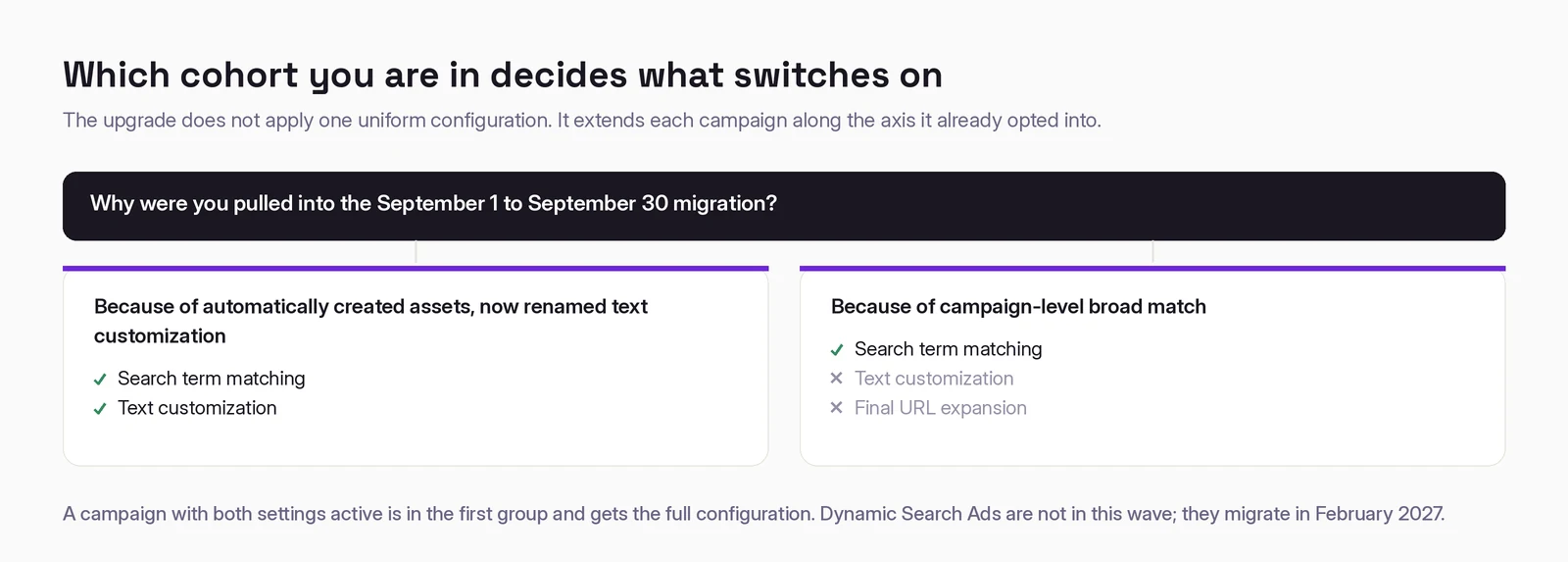
Those are materially different outcomes, and the distinction is worth internalizing because it tells you what Google thinks it is doing. It is not bundling everything for everyone. It is extending each campaign along the axis it already opted into, and the ACA cohort gets more because it had already accepted automated creative.
So before September, the question is not "am I in scope." It is "which cohort am I in, and therefore what specifically turns on." A campaign with both settings active is in the first group and gets the full configuration.
Dynamic Search Ads are not in this wave
DSA campaigns do not migrate on September 1. They migrate in February 2027.
Google plans in-account notifications starting in September, further reminders in January, and automatic upgrades beginning next February.
If you run DSA, this is a reprieve rather than an exemption, and it is a useful one: you get roughly five months to watch what happens to everyone else before it happens to you. That is the best position anyone has in this transition. The mistake would be to file it as "not applicable" now and be surprised in February, put it in the calendar today, while you know why it is there.
What the upgrade actually changes about your account
Underneath the mechanics is the thing worth being clear-eyed about.
Automatically created assets wrote your ad copy. Search term matching decides which queries you are eligible to appear for. Those are different jobs. One is a creative decision; the other is a targeting decision.
The upgrade promotes one into the other. A setting you enabled to get help with headlines now also influences who sees them.
There is a second-order effect worth planning for: AI Max widens the pool of queries you are eligible for, and it does not widen the budget that funds it. The same money now spreads across a broader set of matches. Whether that is good depends entirely on whether the additional queries convert like your existing ones, which is knowable, but only afterward, and only if you set up to measure it.
None of this makes AI Max a bad product. Plenty of advertisers report real gains from it, and broad automated matching genuinely does find volume that manual structures miss. The issue is narrower: there is a difference between choosing automation and inheriting it through a default.
Google's own guidance points the same way, recommending advertisers transition deliberately in order to maintain full control over campaign setup, which is a notable thing to have to say about an automatic upgrade.
What to do before Monday
Identify your cohort, campaign by campaign. Which campaigns run automatically created assets (text customization), which run campaign-level broad match, and which run both. That list determines what changes where.
Decide per campaign, not per account. The right answer will differ. A brand campaign with tightly controlled matching and a prospecting campaign already on broad match are not the same decision.
If you want out, disable the trigger before the upgrade reaches you. Manually turning off campaign-level broad match or automatically created assets removes a campaign from automatic upgrade. Do it before your campaign's conversion date, which, given the month-long window, means doing it now rather than during September.
If you want in, enable it deliberately and configure it yourself. This is a better position than being upgraded, because you choose the settings, you know the date, and you have a clean before-and-after to measure against.
Set your measurement baseline this week. Capture current CPA, conversion rate, and search term composition per campaign before anything changes. After migration, the comparison you need is against a baseline you recorded, not one you reconstruct from memory in November.
Diary February 2027 for DSA. With a note explaining why, for whoever reads it.
The thing to avoid
The failure mode here is not AI Max. It is arriving in October, finding that acquisition costs moved, and being unable to say whether it was the migration, the date it happened, seasonality, or something else entirely, because nobody recorded which campaigns changed or when.
That is an avoidable outcome, and the window to avoid it closes on Monday.
Working out where AI actually fits in your marketing?
I write these while building the systems behind them: measurement, creative pipelines, and agents that do real work. Connect on LinkedIn and tell me what you are working on. That is where these conversations start.
Connect on LinkedIn