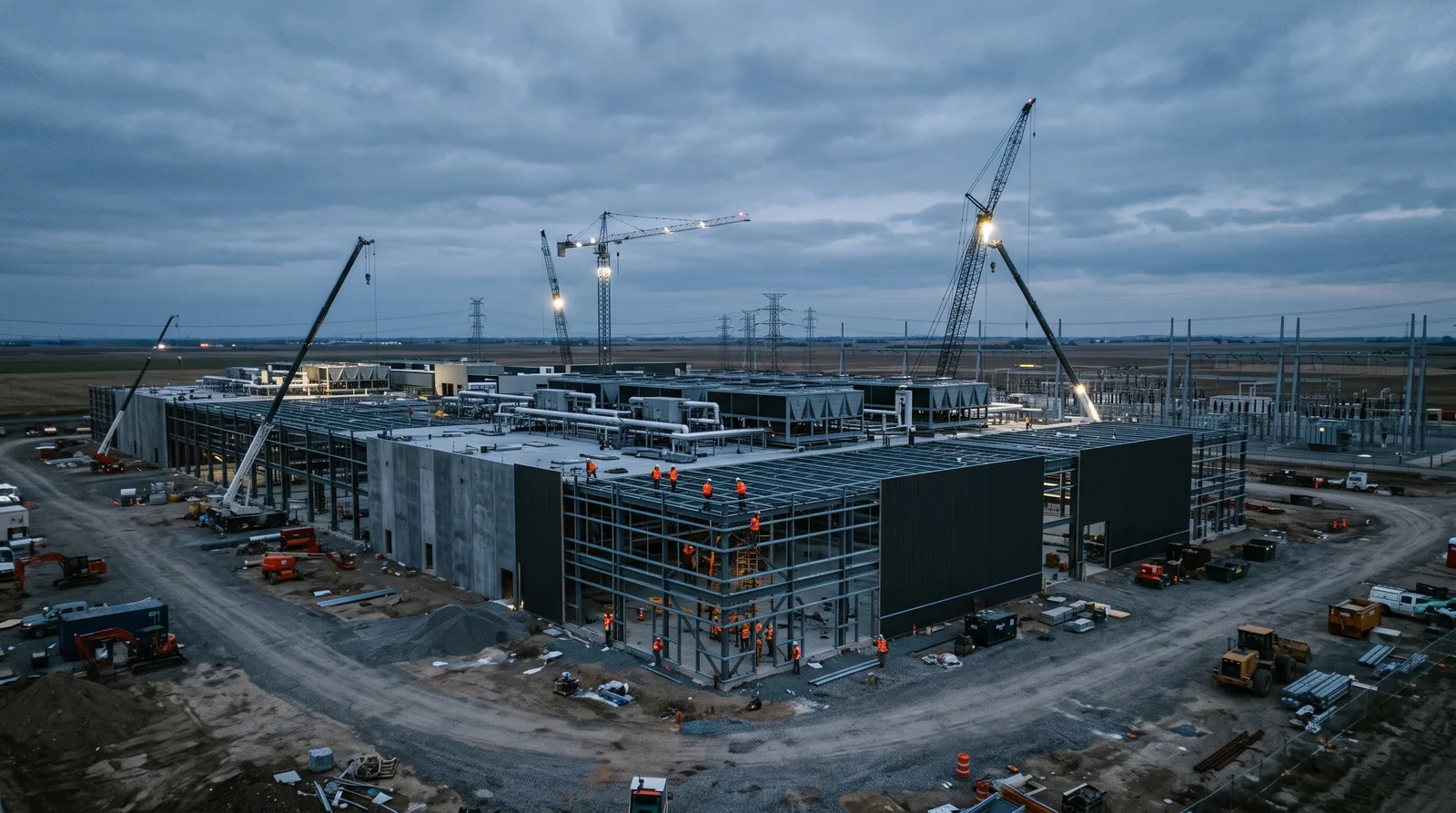
McKinsey puts global data center capital expenditure at $6.7 trillion by 2030. Of that, $5.2 trillion is driven by AI specifically, and more than $4 trillion goes to compute hardware alone.
Numbers at that scale stop meaning anything. Trillions are not intuitive. So the useful question is not how big it is; it is who repays it, and how.
The answer is less abstract than the number suggests.
The spending is not speculative
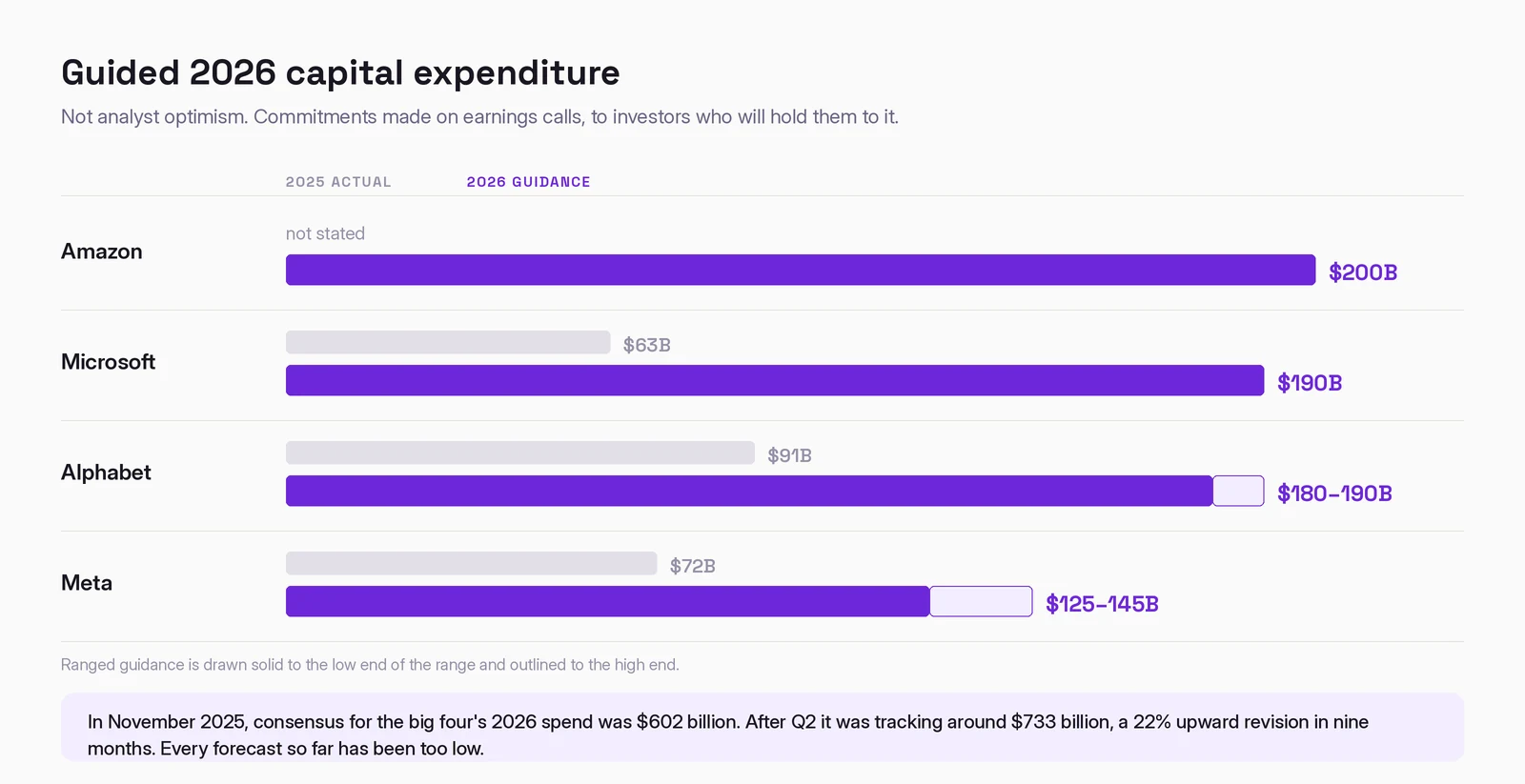
This is not analyst optimism about what companies might do. Most of the near-term figure is already guided to the market.
| Company | 2025 actual | 2026 guidance |
|---|---|---|
| Amazon | $200B | |
| Microsoft | $63B | $190B |
| Alphabet | $91B | $180–190B |
| Meta | $72B | $125–145B |
Microsoft roughly tripled its capital expenditure in a single year. Alphabet doubled. These are not projections; they are commitments made on earnings calls, to investors who will hold them to it.
And the estimates keep climbing. In November 2025, consensus for the big four's 2026 spend was $602 billion. After Q2 it was tracking around $733 billion, a 22% upward revision in nine months.
Every forecast so far has been too low. That pattern is more informative than any single number in this article.
Capital expenditure is not charity
Here is the part that gets skipped in the coverage, and it is the part that matters if you buy media or software for a living.
Capex has to earn a return. That is what makes it capex rather than philanthropy. And the return has to come from an existing revenue line, because these companies are not inventing new ones fast enough to cover $700 billion a year.
For Alphabet and Meta, that revenue line is advertising. For Microsoft and Amazon, it is cloud and enterprise software.
Which means the repayment mechanism for the largest infrastructure build-out in modern commercial history runs directly through your ad account and your cloud invoice.
This is not a conspiracy and it does not require anyone to behave badly. It is just what happens when a company commits to spending three times what it spent last year and has one dominant way of making money.
What that actually looks like
It does not look like a price spike. Spikes are visible and provoke a reaction.
It looks like sustained structural pressure on monetization:
More ad load. Surfaces that did not carry advertising begin to. Formats get denser. The ratio of content to advertising shifts by degrees.
More automated placement. Automation is usually framed as an efficiency feature for advertisers. It is also a yield feature for the platform, it widens the inventory an advertiser will accept and reduces the friction of declining it.
Higher floors. Not a dramatic increase in headline CPMs, but a steady erosion of the cheap end of the auction.
Fewer opt-outs. Controls that were previously optional become defaults, and defaults become the only setting.
If you have felt each of those individually over the last eighteen months and filed them as unrelated product decisions, this is the thing they have in common.
The constraint nobody can spend past
There is one limit on this that capital cannot solve.
That build-out requires an estimated 219 gigawatts of new power capacity by 2030.
Money is genuinely the easy part of this equation. Grid interconnection queues, turbine manufacturing lead times, transmission line permitting and substation construction are not responsive to urgency or to balance sheet size. You cannot pay a grid operator to make a five-year interconnect study into a five-month one.
This is why the interesting reporting over the next three years will be about electricity rather than chips. Compute is a supply chain problem, and supply chains eventually respond to money. Power is an infrastructure and permitting problem, and those respond to time.
If the build-out slips, it will slip on watts, not dollars.
What to do with this
Assume monetization pressure is structural, not cyclical. Budget on the basis that the cheap end of the auction keeps thinning and that platform automation keeps expanding its default scope. Plans built on 2024 efficiency assumptions will not hold.
Read platform product announcements as yield decisions. When a new automated placement or expanded inventory type ships, the advertiser-facing benefit is real, and so is the platform's need to fill more inventory. Both things are true simultaneously.
Watch power, not just capex. The leading indicator for whether this build-out lands on schedule is interconnection queues and power purchase agreements, not chip announcements.
Be skeptical of the forecasts, in the direction they have actually been wrong. Every revision so far has been upward. That does not guarantee the next one is, but the base rate is not neutral.
The spending is real and largely committed. The repayment runs through the platforms you buy from. The binding constraint is electricity, not capital.
None of that is a reason for alarm. It is a reason to plan the next three years with the right model of what is driving your suppliers' behavior, because they are not making these decisions casually, and neither should you.
Working out where AI actually fits in your marketing?
I write these while building the systems behind them: measurement, creative pipelines, and agents that do real work. Connect on LinkedIn and tell me what you are working on. That is where these conversations start.
Connect on LinkedIn