
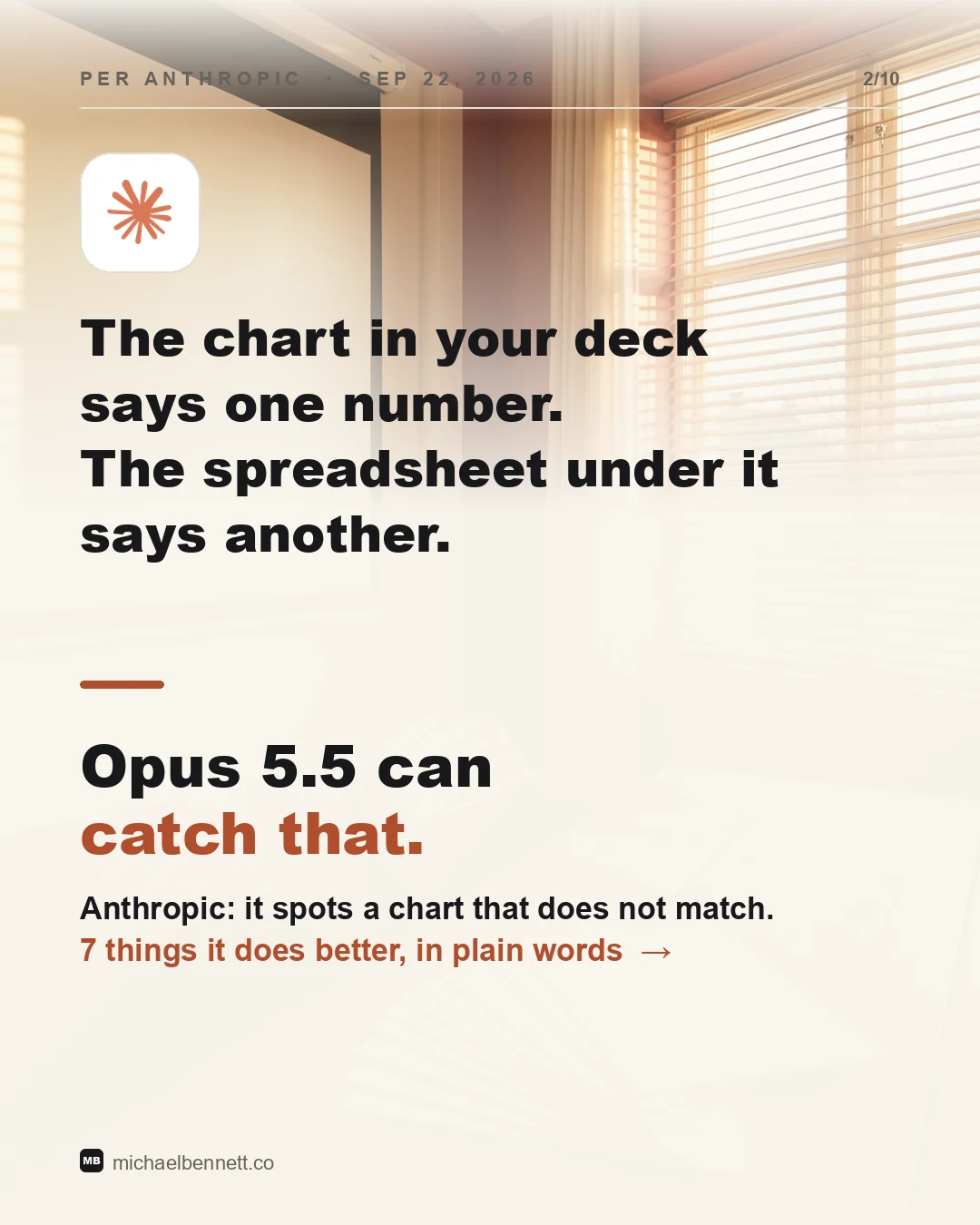
The chart in your deck says one number. The spreadsheet under it says another. Anthropic says its new model, Claude Opus 5.5, released September 22, 2026, catches that kind of mismatch. It is the first of 7 claims below that land in everyday work: spreadsheets, decks, Word docs, email recaps and dashboards. No code involved.
What it is, and who gets it. Opus 5.5 is Anthropic's newest model for the Claude app. It is the default model on the Pro, Max and Team plans, and it is available on Enterprise. The Free plan is not listed. You type what you want in plain words, the same way you already use Claude.
A word on scope before the list. Every claim and test below is Anthropic's own. I found no independent hands-on review of office work within a day of launch. Where the reasoning is mine, it says "My read".

1. A second pair of eyes before you hit send
Date and source: September 22, 2026. Anthropic's prompting guide for Opus 5.5.
The takeaway. Give it a long planning thread, a big workbook, or a deck with the figures behind it. Anthropic's words: “it catches details that are easy to miss in large inputs, such as a date in a long planning thread that falls on the wrong weekday or a chart in a slide deck that doesn't match the underlying figures.”
One early tester, Izzy Miller of Hex, told Anthropic: “Claude Opus 5.5 keeps digging past the first plausible answer.” That is a customer quote Anthropic chose for its own page, not an independent review.
What it means for your work. My read: treat it as a check, not a sign-off. It can point at the chart that looks wrong. You still decide whether it is.
Try this. Upload your next deck with its spreadsheet and ask which charts do not match.
2. Files you can send with fewer fixes
Date and source: September 22, 2026. Anthropic's prompting guide for Opus 5.5.
The takeaway. Ask Claude in plain words for an Excel sheet, a PowerPoint or a Word doc, then download the file. Anthropic says of Opus 5.5: “The spreadsheets, slides, and documents it produces need less editing before you share them.”
Keep two things apart. Making files is a general Claude feature that has existed since September 2025. Anthropic's Help Center describes it this way: “Prompt Claude using natural language to generate Excel spreadsheets, PowerPoint presentations, Word documents, and PDF files that you can download and use immediately.” What is new is the claim about Opus 5.5: a better first draft.
What it means for your work. My read: the useful measure is how many edits a file needs before it goes out, and that is something you can count yourself.
Try this. Ask for next week's report as a Word doc and count the edits it needs.
3. Writing that gets to the point
Date and source: September 22, 2026. Anthropic's launch post.
The takeaway. Anthropic says Opus 5.5 leads with the point, drops the jargon and keeps to your rules: “It puts the most important information up front, is less likely to use jargon or idiosyncratic phrases, and follows the writing rules you give it.” It also says: “Its messages are much easier to understand at a glance, which testers said helped during long working sessions.”
John Ruelas of Ramp, another early tester quoted on Anthropic's page: “It writes like a good colleague, and follows our writing rules.”
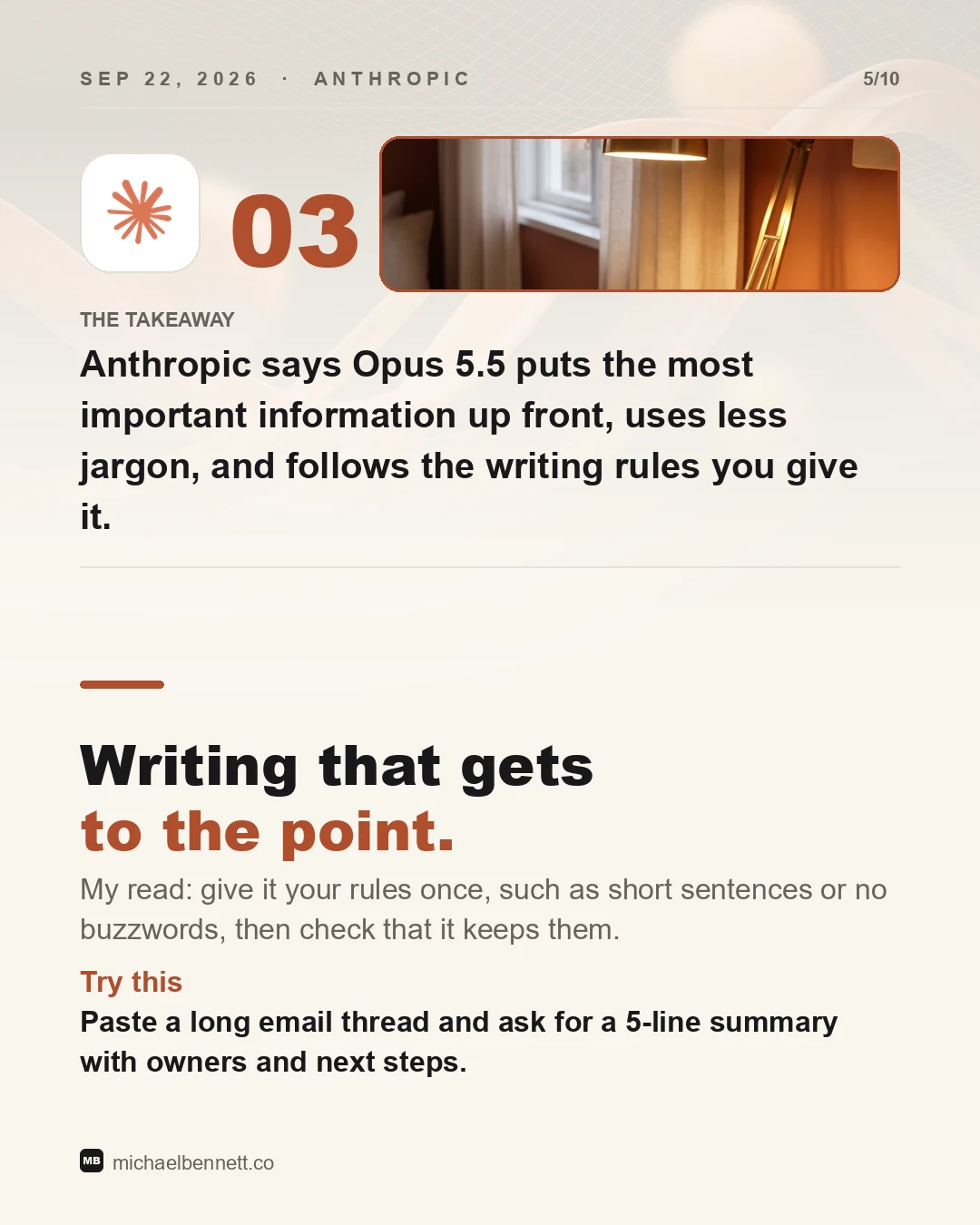
What it means for your work. My read: give it your rules once, such as short sentences or no buzzwords, then check that it keeps them.
Try this. Paste a long email thread and ask for a 5-line summary with owners and next steps. Only paste threads you are allowed to share.
4. Screenshots it reads more accurately
Date and source: September 22, 2026. Anthropic's prompting guide for Opus 5.5.
The takeaway. Paste a screenshot of a dashboard, a chart or a calendar. Anthropic says that “even at its lowest effort setting it read values off dense charts more accurately than Claude Opus 5 did at its highest”. Anthropic also says: “It is better, too, where meaning depends on position rather than text: which boxes an arrow connects in a flowchart, what changed between two versions of a diagram, or exactly when a meeting starts and ends in a calendar screenshot.”
What it means for your work. My read: this is the fastest win for anyone who lives in ad or sales dashboards.
Try this. Paste your messiest report screenshot and ask for the 3 numbers to worry about.
5. A spreadsheet and a deck in about an hour
Date and source: September 22, 2026. An internal test described in Anthropic's launch post.
The takeaway. Anthropic ran Opus 5.5 and the older Opus 5 on the same job: “Each built a financial model in Excel, then turned it into an executive presentation on whether the deal made sense at its price.” The result, in Anthropic's words: “Opus 5.5 finished in 63 minutes compared to 93 for Opus 5”, and “Both models reached the same conclusions about the deal, but Opus 5.5’s model was more thorough and its presentation easier to read, while Opus 5’s had minor errors.”
What it means for your work. Both models got to the same answer. The difference Anthropic reports is time, a more thorough spreadsheet and a deck that is easier to read. My read: the part to borrow is the order of work. Start from numbers you trust, then ask for the slides.
Try this. Give it a spreadsheet you already trust and ask for a 5-slide summary deck.
6. Research that invents fewer numbers
Date and source: September 22, 2026. An internal test described in Anthropic's launch post.
The takeaway. Anthropic's test: “In one internal test, we asked Opus 5.5, Fable 5.1, and Opus 5 to write a report on a company’s quarterly performance using only the information it could find on a copy of the web where the earnings release was hard to locate.” Then: “An automated grader checked every figure and quote against sources.” The result:
“Across different effort settings, 16 out of 18 of Opus 5.5’s reports cleared our quality bar, where any invented figure or quote would have failed. Neither Fable 5.1 nor Opus 5 cleared that bar in any attempt.”
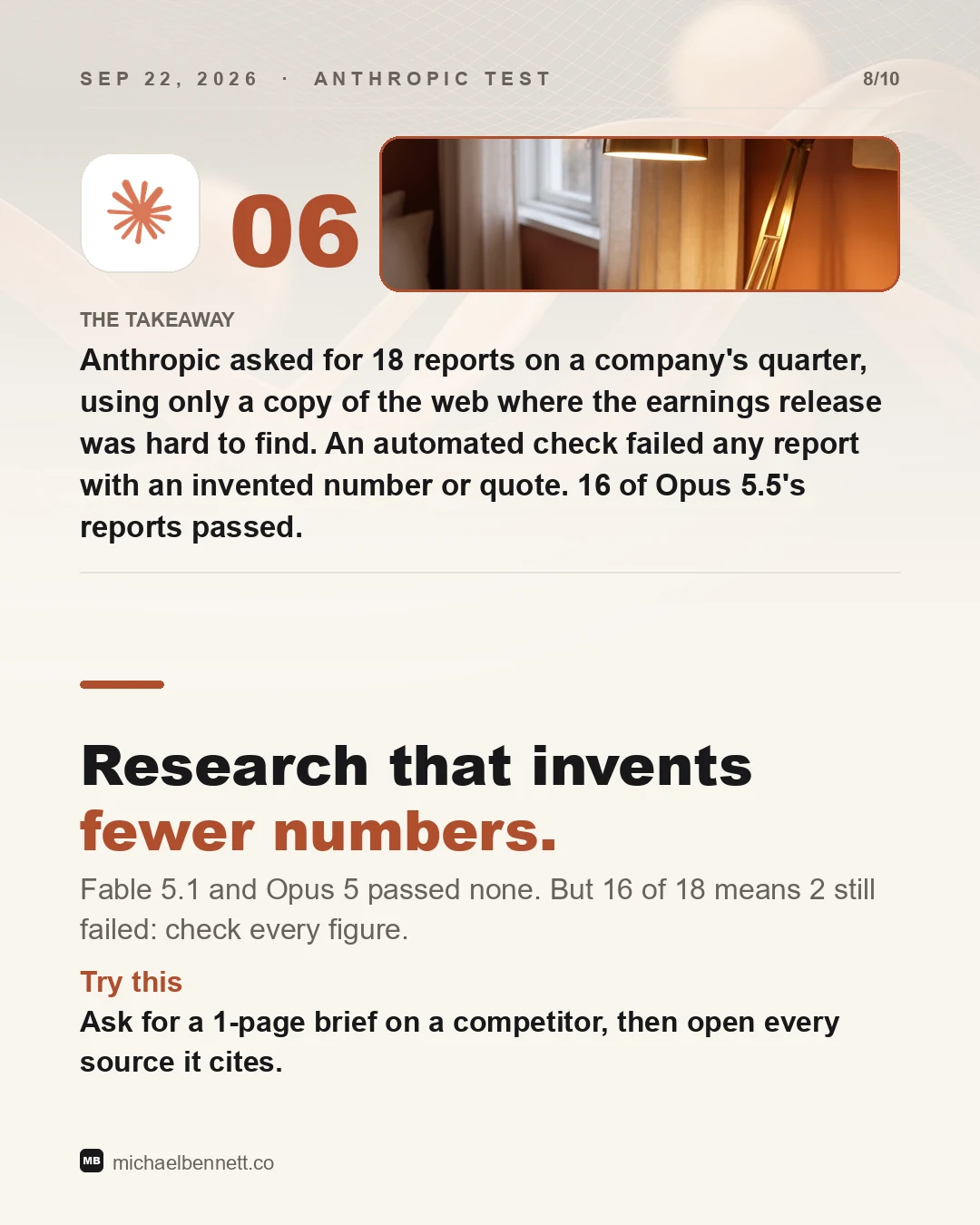
What it means for your work. Fable 5.1 passed none. My read: that is a striking result, but 16 of 18 means 2 still failed, and a report with 1 invented number looks exactly like a report with none. Check every figure.
Try this. Ask for a 1-page brief on a competitor, then open every source it cites.
7. More room to work on a paid plan
Date and source: September 22, 2026. Anthropic's launch post, and Anthropic's Cat Wu on X.
The takeaway. Opus 5.5 is the default model in the Claude app on Pro, Max and Team, and available on Enterprise. Anthropic also raised the 5-hour usage limits, the cap on how much you can use Claude in a 5-hour window: “we’re increasing five-hour usage limits on Pro, Max, Team, and seat-based Enterprise plans.” Cat Wu of Anthropic put a number on it: “Your rate limits will go 25% further on Opus 5.5 compared to Opus 5.”
What it means for your work. Anthropic announced no change to plan prices. My read: if you have hit the limit halfway through a big task before, this is the change you will notice first.
Try this. Save your hardest task of the week for it and see how far your limit goes.
Let it draft. You check.
3 things to try today, straight from the carousel:
- Paste a dashboard screenshot and ask for the 3 numbers to worry about.
- Give it a spreadsheet and ask it to find anything that looks wrong.
- Paste a long thread you are allowed to share and ask for a 5-line summary.
These are Anthropic's own claims and tests. Check every number before it leaves your hands.
What Anthropic did not say
That it runs in the Excel or PowerPoint add-ins. Claude has add-ins that work inside Excel and PowerPoint, but they predate this model. The Excel page says the add-in offers “a curated subset of the Claude models” and does not name Opus 5.5. No Anthropic page I read says Opus 5.5 is in either add-in. The same page does not recommend the add-in for “Final client deliverables without human review”.
That it is Anthropic's most capable model. It is not. Fable 5.1 sits above it in Anthropic's own lineup. Anthropic says Opus 5.5 “performs at the level of Claude Fable 5.1 on most work”, and adds a caution about its own scores: “at these levels of capability we’ve found that benchmark margins have become a less reliable guide to real-world differences.”
That its tests are independent. The deck test and the research test above were run and graded by Anthropic. The quotes from Hex and Ramp are early testers Anthropic chose for its page.
That it never makes things up. In Anthropic's own research test, 2 of 18 reports failed.
Sources: verified September 23, 2026 against Anthropic's launch post of September 22, 2026, the Claude Opus product page, Anthropic's prompting guide and model overview for Opus 5.5, 3 Claude Help Center pages (file creation, Claude in Excel, release notes), and Cat Wu's post on X. Quotations are exact. Lines marked My read are mine, not Anthropic's. Every source, with its URL, is listed in SOURCES.md.
Working out where AI actually fits in your marketing?
I write these while building the systems behind them: measurement, creative pipelines, and agents that do real work. Connect on LinkedIn and tell me what you are working on. That is where these conversations start.
Connect on LinkedIn