
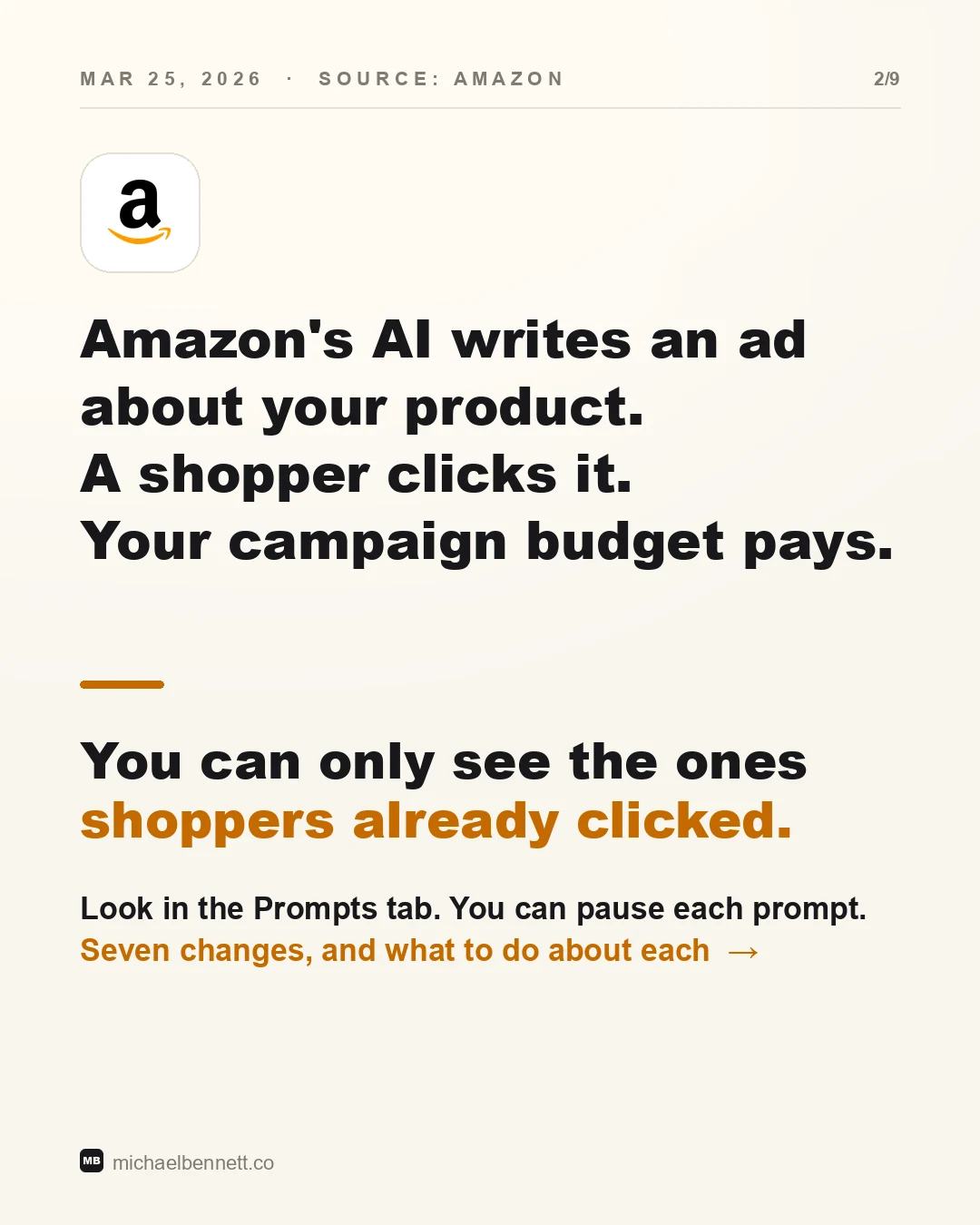
Amazon's AI writes an ad about your product. A shopper clicks it. Your campaign budget pays.
That has been true in the United States since March 25, 2026, for Sponsored Products and Sponsored Brands. (Sponsored Products are ads for a single product. Sponsored Brands are ads that show a brand and several products.) You did not write the ad, and you did not sign up for it. Amazon says campaigns “will be automatically enrolled in prompts”.
Six more changes follow. One has a deadline in December, and what it deletes cannot be recovered.
1. You pay for clicks on ads Amazon's AI wrote
Date: announced March 10, 2026. Generally available, and billed, in the US from March 25, 2026.
What changed. Amazon calls the format a prompt: a short question or statement about your product, generated by Amazon, shown in search results and on product pages. A click can open Rufus, Amazon's shopping assistant, or answer the shopper on the page.
The open beta from November 2025 was not charged. Then billing started. Amazon's words:
“Sponsored Products prompts and Sponsored Brands prompts were introduced in November 2025 in open beta. As we move to general availability in the U.S., we will begin to charge for these ads as part of your CPC bidding and billing parameters. If you'd like to pause a prompt, you can do so at any time in Ad Console.”
The scope is the US only, and Amazon's page excludes authors and publishers.
Two limits. What Amazon documents is pausing an individual prompt, not a switch that turns prompts off. And you cannot review every prompt before it runs. The Prompts tab sits at Campaign, Ad Group, Ads, and Amazon says prompts are listed there “if they have received a click”.
What it does to your numbers. My reasoning, not Amazon's statement: compare early 2026 with the months after March 25 on a US account, and some of the change in spend is a new billed placement. Nothing in your campaign setup changed to tell you.
Do this. Open the Prompts tab on your top ad groups. Read each prompt. Pause any that misstate a claim, which costs nothing and can be reversed. Then pull a Prompts report for a period that spans March 25. It includes spend, sales and ACOS, which is ad cost as a share of sales.
2. Your ads can now run in influencer content
Date: August 10, 2026, according to an advertiser email reported by PPC Land. Amazon published no announcement, and its help page carries no start date.
What changed. Sponsored Products ads have run on other sites and apps since October 2023. What is new is where: inside content made by Amazon's influencers and affiliates, in 14 countries. Amazon's help page: “Creator content: Creators in the Amazon Influencer and Associates Program with a track record of driving traffic or sales on Amazon can select your campaign to feature in their product reviews, editorial content, and buying guides.”
The campaign setting that governs this has two positions, Increase reach off-Amazon and Limit reach to Amazon. Amazon's page labels the first one the default.
You do not pay creators to make content. You pay for clicks on your ads inside it. Amazon: “Your maximum bid applies to every click, whether on or off Amazon, and every click counts toward the same campaign budget.” On the creator's share, Amazon says only this: “Creators may receive a portion of the CPC from qualifying clicks.”
What it does to your numbers. The bid multipliers you tuned for search do not follow your ads off Amazon. Amazon: “Bid adjustments for Top of Search, Rest of Search, and Product Pages do not apply to off-Amazon placements.” My read: if this traffic converts below search traffic, ACOS rises on campaigns nobody edited.
Do this. Pull a Placement report for a window that spans August 10 (PPC Land's reported date). Compare off-Amazon ad cost against sales before changing anything.
Two warnings before you touch a setting. Switching has a cost that Amazon states itself: “Limit reach to Amazon: Ads appear only on Amazon owned-and-operated properties. This may reduce impressions and sales opportunities.” You can switch back, but treat it as a budget decision. And if you block creators or sites with a deny list, clearing that list cannot be undone. Amazon says you will “get a prompt indicating that the action is non-reversible” and that you should download the list first.
3. Amazon deletes your saved reports on December 31
Dates: December 17 and December 31, 2026. Amazon marks both as subject to change.
What changed. Amazon is not shutting down reporting. Its new unified reporting became generally available on June 8, 2026. The two old report pages, Sponsored Ads reports and Amazon DSP reports, are being retired. (DSP is Amazon's demand-side platform, the tool for buying display and video ads.) Amazon's help page:
“Sponsored ad reports and Amazon DSP reports are shutting down on December 31, 2026. After this date, all saved reports, scheduled reports, and historical data still on these pages will be permanently deleted.”
The working deadline is two weeks earlier. For December 17, Amazon says “net new report creation and editing will be disabled. Existing reports will remain available in read-only mode.”
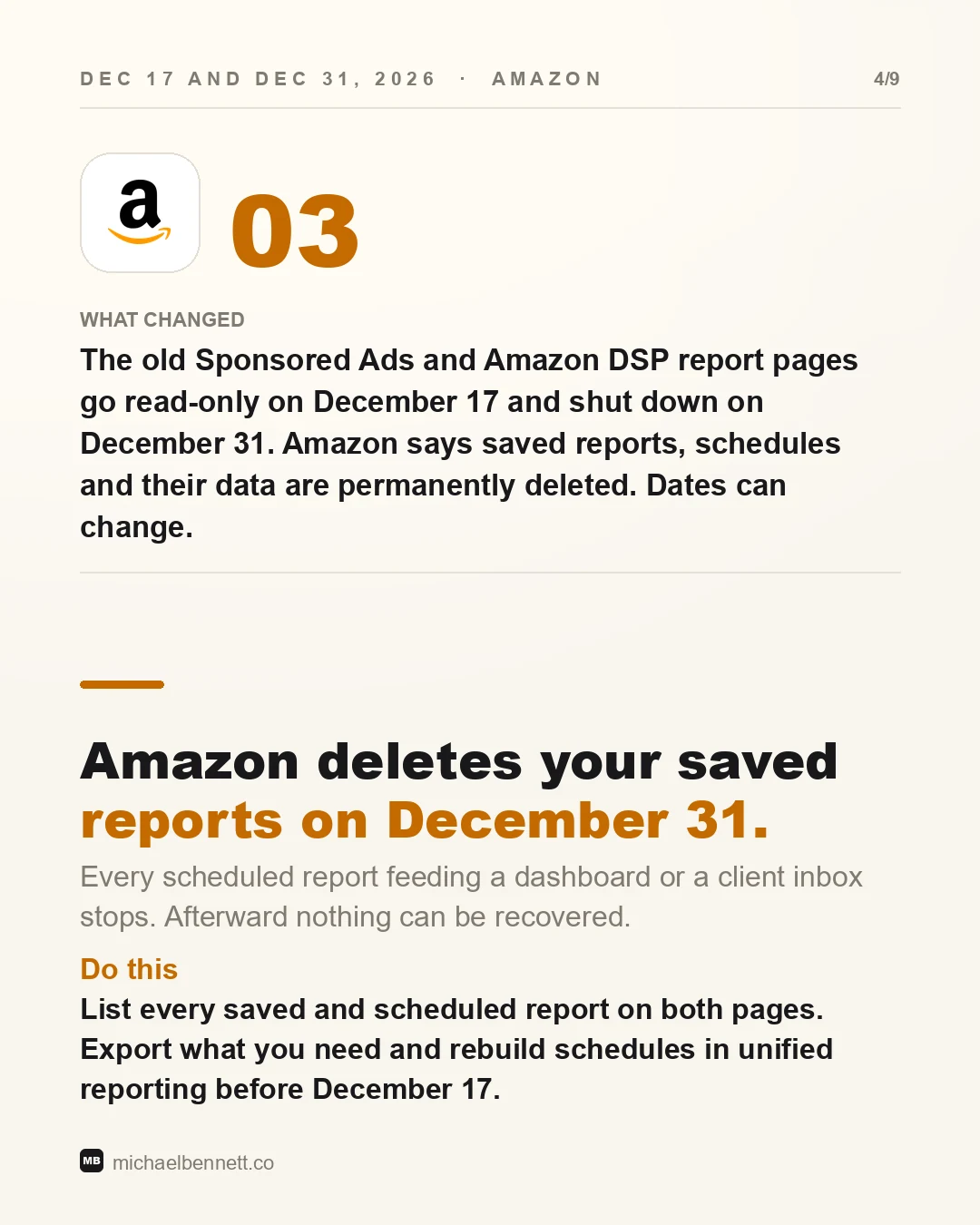
What it does to your numbers. Every scheduled report that feeds a dashboard or a client inbox stops. Afterward nothing can be recovered. Amazon says it standardized its attribution method in the same release. My reasoning: a report rebuilt in unified reporting may not return the old number.
Do this. List every saved and scheduled report on both pages. Export what you need and rebuild the schedules in unified reporting before December 17.
4. Amazon changed how it counts view-based sales
Date: January 1, 2026.
What changed. View attribution is the credit an ad gets when someone saw it, did not click, and bought later. On January 1 Amazon replaced the model behind it with what it calls a shopping-signal enhanced last-touch model. Amazon says it “applies a shorter attribution window to reflect shopper behavior in the store.” Amazon never says how short.
It covers three things: Sponsored Brands, Sponsored Display campaigns billed by impressions, and DSP ads that run in the Amazon Store. Everything else stayed as it was: “Conversion reporting for all other campaign types and inventory types remains unchanged. Click-based attribution remains unchanged.” It is still a last-touch model.
What it does to your numbers. My read: return on ad spend on those campaigns is a different number on the same media. A chart that crosses January 1 compares two methods. Amazon does not say which way the numbers move.
Do this. Amazon kept the earlier basis as a second set of metrics. Compare Purchases with Purchases (all views) across December and January. Mark January 1 on your dashboards.
5. A connected AI tool can delete your campaigns
Dates: February 2, 2026, open beta. July 6, 2026, browser login added.
What changed. An MCP server is a standard connector that lets an AI assistant operate a piece of software. Amazon opened one in open beta, and it is not read-only: “Once connected, the Amazon Ads MCP Server allows agents to access individual Amazon Ads capabilities such as creating, updating, or deleting campaigns; running performance and reporting queries; managing account-level settings; and accessing billing and financial data.”
It is not open to every advertiser login. Amazon says the beta is for partners with active API credentials, the keys a software tool uses to reach your account.
What it does to your numbers. My read: this is write access to live spend, and few companies have a rule for who may connect one.
Do this. List who holds API credentials and which tools use them. Never test an agent on live campaigns. Its changes are real and spend real money.
6. New tool connections now expire after one year
Date: July 30, 2026.
What changed. When you connect a tool to Amazon Ads, you approve it once, and a refresh token, a stored credential, keeps it connected. Amazon's release note: “Effective July 30, 2026, refresh tokens issued on or after that date expire 365 days from the date of advertiser consent.” Using the tool does not extend it. Approvals granted before July 30 are not affected.
What it does to your numbers. Nothing broke this year. My read: a bid tool, feed tool or report connected this fall stops next fall unless someone approves it again.
Do this. Ask each vendor in writing: when was our token issued, and what happens when it expires?
7. Amazon is piloting ads inside ChatGPT
Date: September 10, 2026. A US pilot.
What changed. Amazon's announcement: “Select advertisers in the U.S. are currently testing ChatGPT Ads as part of a pilot.” The ads are bought through Amazon Ads. No pricing, reporting or general release date is published.
What it does to your numbers. Nothing yet, for almost everybody. My read: Amazon is becoming a seller of ad space in another company's assistant.
Do this. Ask your Amazon rep one question: are we eligible? Do not move budget for a pilot you are not in.
What to do this week
Three checks. One has a deadline.
- Open the Prompts tab on your top ad groups. Read each prompt, pause any that misstate a claim, and pull a Prompts report.
- List saved and scheduled reports on the old pages, and export before December 17.
- Pull a Placement report across August 10 (PPC Land's reported date) before touching the off-Amazon setting.
Two of these spend your budget by default. Read the Prompts tab before the next invoice.
Sources: verified September 21, 2026 against Amazon Ads announcements, help pages and API release notes. The August 10 start for creator content comes from one trade source, PPC Land, reporting an advertiser email I could not open. Amazon marks the December dates as subject to change. Quotations are exact. Lines marked my read or my reasoning are mine.
Working out where AI actually fits in your marketing?
I write these while building the systems behind them: measurement, creative pipelines, and agents that do real work. Connect on LinkedIn and tell me what you are working on. That is where these conversations start.
Connect on LinkedIn