
Confirmation bias is not new. Every business case ever written started with someone who already knew the answer and went looking for the support.
What is new is that it now comes with a research engine.
Anthropic's Founder's Playbook makes the point directly: ask AI to validate your idea and it will find evidence for it; ask it to size your market and it will return the number that makes the opportunity look fundable. That is not a defect report. It is a description of what the tool does when you point it somewhere.
The uncomfortable version of this is that you can now build an elaborate, well-sourced, professionally formatted case for a bad decision faster than you ever could before, and feel more confident about it, because it looks like diligence.
The output looks like research
This is the mechanism worth understanding, because it is not really about AI.
A weak argument used to announce itself. Thin sourcing looked thin. A market estimate built from one optimistic assumption looked like one optimistic assumption. The presentation carried information about the rigor behind it, because producing a polished document was expensive enough that nobody polished a case they hadn't done the work on.
That coupling is gone. Structure, citations, and confident prose now cost about forty minutes. The signal that used to tell you "someone worked hard on this" now tells you almost nothing, because the effort it once proxied for is no longer required.
So you get an echo with footnotes, and it is genuinely difficult to tell apart from analysis.
The problem is not that the model lies to you. On the facts it is usually right. The problem is that it complies with you. You set the direction; it builds the road. A question phrased as "help me make the case for X" is not a research request. It is a drafting brief, and it will be executed as one, competently, with sources, in your preferred format.

Point it the other way
The fix is not a better tool or a cleverer prompt library. It is noticing that you control the direction and that you have been aiming it at your own conclusion.
Instead of "help me build the case for this":
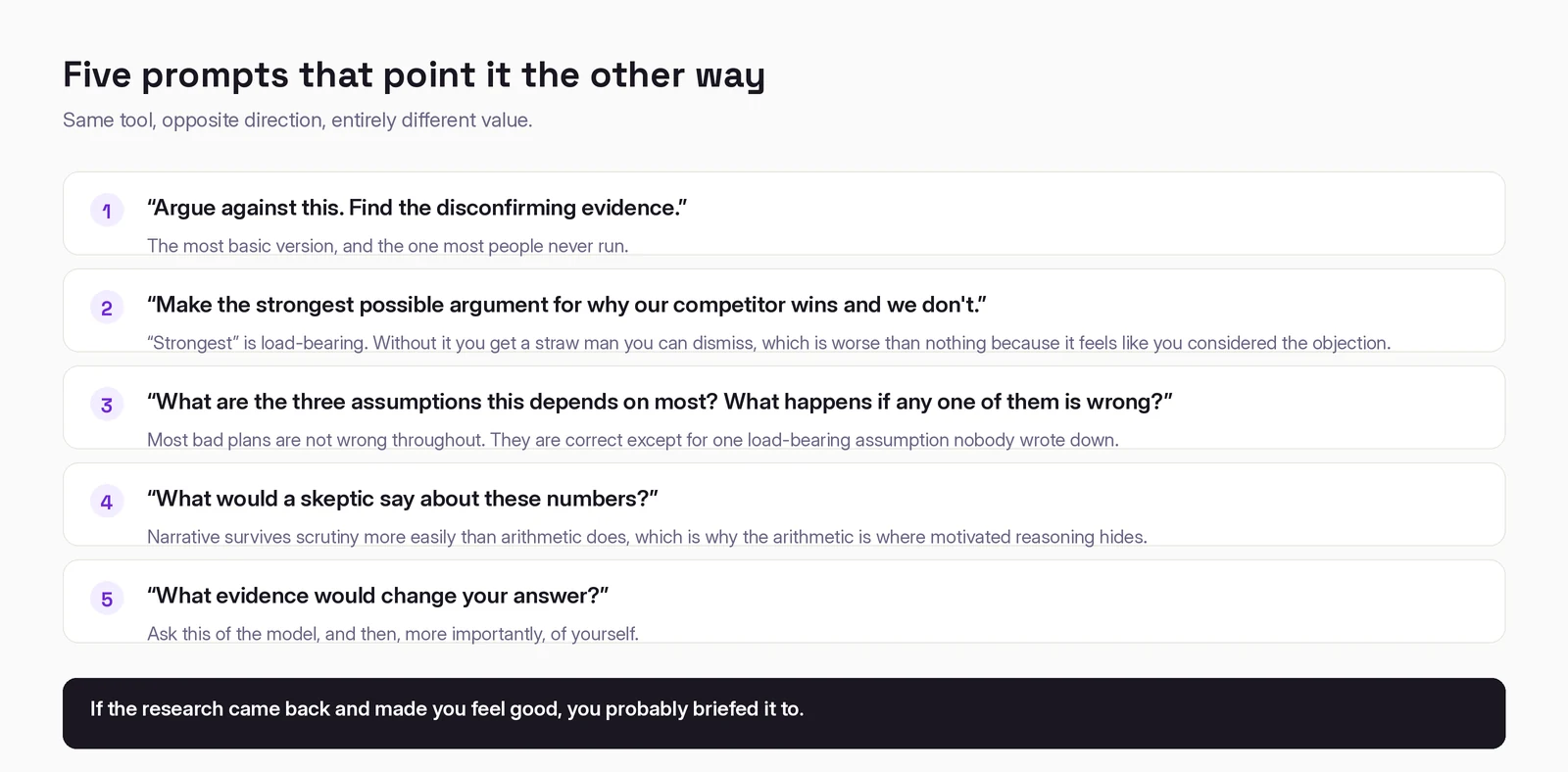
"Argue against this. Find the disconfirming evidence." The most basic version, and the one most people never run. Note how much less pleasant the output is.
"Make the strongest possible argument for why our competitor wins and we don't." The word strongest is load-bearing. Without it you get a straw man you can dismiss, which is worse than nothing because it feels like you considered the objection.
"What are the three assumptions this depends on most? What happens if any one of them is wrong?" This one is the most useful in practice. Most bad plans are not wrong throughout; they are correct except for one load-bearing assumption nobody wrote down. Forcing the assumptions into a list makes them arguable.
"What would a skeptic say about these numbers?" Specifically the numbers. Narrative survives scrutiny more easily than arithmetic does, which is why the arithmetic is where motivated reasoning hides.
"What evidence would change your answer?" Ask this of the model and then, more importantly, of yourself. If nothing would change your mind, you are not doing analysis. You are doing procurement for a decision already made.
Same tool. Opposite direction. Entirely different value.
The tell is discomfort
Here is the practical heuristic, and it is the part I would keep if you forget everything else.
If the research came back and made you feel good, you probably briefed it to.
Genuine analysis of your own plan is mildly unpleasant approximately always, because any plan worth running has real risks and a real chance of failure, and an honest account of it will say so. Output that is uniformly encouraging is not evidence that your idea is strong. It is evidence about the question you asked.
This is not a reason to distrust the tool. It is a reason to distrust a specific feeling, the one where the document confirms what you hoped and you move to the next agenda item slightly faster than you should.
Where this bites hardest
Three situations where the failure mode is most expensive:
Market sizing. TAM is the single most motivated number in business, and it is assembled from assumptions rather than measured. An AI asked to size a market will make reasonable choices at every step, and reasonable choices selected in a consistent direction compound into a number nobody should act on. Ask for the bear case with the same rigor and see how far apart they land. The distance between them is the real finding.
Competitive analysis. Nearly always written by the party that intends to compete, which means the conclusion is fixed before the research starts. The useful exercise is to have the model write your competitor's investment memo, the one that explains why they win, and to do it well enough that it stings.
Post-mortems and business cases for things already underway. The strongest gravitational pull of all, because the decision is made, money is spent, and the analysis exists to justify continuing. This is where "what evidence would change your answer?" earns its keep.
The point
The most valuable thing AI can do for your strategy is not confirm it.
It is survive an honest attempt to destroy it.
That attempt has never been cheaper to run. It takes one differently worded prompt and about forty minutes, the same forty minutes you would otherwise spend building a beautifully sourced argument for something you had already decided.
Which raises the only question that matters here: what is the last decision you asked AI to argue against?
Working out where AI actually fits in your marketing?
I write these while building the systems behind them: measurement, creative pipelines, and agents that do real work. Connect on LinkedIn and tell me what you are working on. That is where these conversations start.
Connect on LinkedIn