Everyone is describing agentic media buying as programmatic's next step. The data describes something else: a return to the way television has always been bought.
Not as a metaphor. As a mechanism.
What the numbers actually show
DataBeat builds a monthly US trends series from anonymized data across a network tracking more than $55 million in monthly revenue, 35 billion monthly impressions, and signals from over 200 bidders. Its June 2026 edition compared agentic and conventional buying directly.
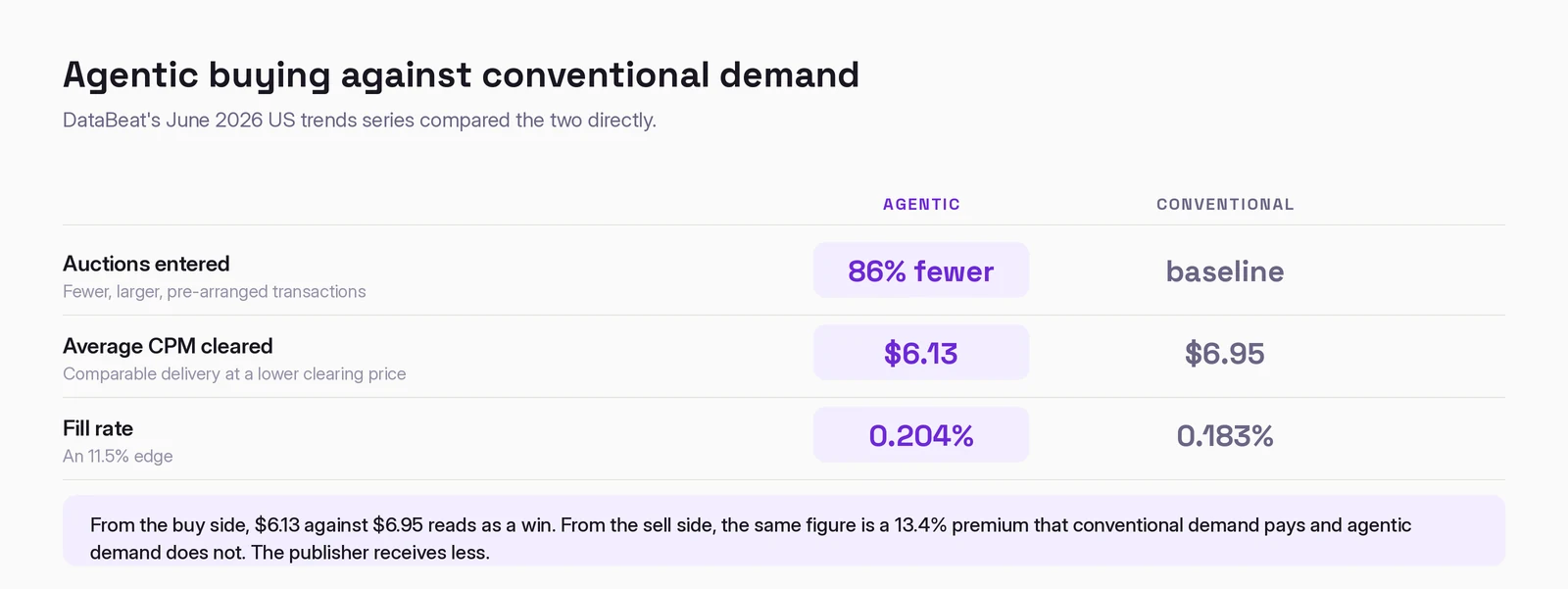
Agentic buyers took part in 86% fewer auctions than conventional demand.
Not eight percent. Eighty-six.
And they got comparable results doing it. Agentic buying cleared at an average $6.13 CPM against $6.95 for conventional programmatic, while posting a higher fill rate, 0.204% against 0.183%, an 11.5% edge.
Fewer, larger, pre-arranged transactions. Comparable delivery. Lower clearing price.
That is not a more efficient auction. That is an upfront.
There is a detail in those numbers that deserves attention, because it points at who is paying for the efficiency. From the buy side, $6.13 against $6.95 reads as a win. From the sell side, the same figure is a 13.4% premium that conventional demand pays and agentic demand does not. The publisher receives less.
Efficiency and transfer look identical in a CPM. They are not the same thing, and which one this is depends on where you sit.
The tell almost nobody is discussing
On July 30, IAB Tech Lab shipped version 2.3 of its agentic advertising framework. Among the additions: a pricing provenance field, letting organizations trace where a CPM originated and preventing an agent from inventing a price when the underlying data is not available. Alongside it, server-side trust verification and a vendor approval gate.
Sit with that for a moment.
In an open auction, a price cannot be fabricated. It is not something any single participant supplies. Other bidders produce it, competitively, and the number that emerges is evidence of itself. That is the entire epistemological trick of an auction: the mechanism generates the proof.
Needing a dedicated field to record where a price came from, and to stop an agent from inventing one, is an admission that the mechanism which made prices self-evidencing has been removed.
The framework's own reasoning is explicit: these controls became necessary precisely because competitive bidding no longer produces the price.
Competition used to supply trust automatically, as a byproduct. Now trust has to be asserted, recorded, verified, and audited.
That is not programmatic logic. That is currency logic. It is exactly how television always worked, and it is why television needed ratings bodies, guarantees, make-goods, and third-party verification, an entire apparatus that exists because there is no auction generating the number.
We already ran this experiment
Connected TV is the control group, and it has been running for years.
CTV adopted programmatic pipes while keeping television's commercial norms. The pipes won on plumbing; the norms won on everything that mattered.
IAB data placed 85% of CTV inventory as programmatically purchased, up from 75% a year earlier. Near-total adoption of the mechanism.
And yet IAB research published in July 2026 found 43% of CTV buyers doubt where their ads actually ran. Confidence sits at 57% even for publisher-direct and guaranteed deals, and 33% for open exchange.
Read those together. The pipes are programmatic. The confidence is televisual, which is to say, contingent on verification rather than produced by the transaction. Buying it programmatically did not make it self-evidencing. It made it fast.
Agentic buying is now applying that same pattern to everything else.
The honest question
The question is not whether agents work. On the delivery metrics they plainly do, and the DataBeat comparison is the strongest evidence anyone has published.
The narrower question is this: is removing per-impression comparison a cost saving, or a value transfer?
If agents negotiate better terms through scale and fewer, larger deals, that is real efficiency and everyone gains from the reduced transaction overhead.
If agents clear lower because the competitive check that used to discover the price has been switched off, the saving is not created. It is moved, from publishers to buyers, and the CPM gap is the receipt.
Nobody has published outcome data that separates these two explanations. The market is standardizing the mechanism regardless, which is normal: standards follow adoption, they do not wait for evidence.
What to do about it
Check your contracts against the new mechanism. If your agreements assume a bid request, a bid response, and an inspectable supply chain, agent-negotiated deals executing inside signed containers satisfy none of those assumptions. That is worth finding before renewal season, not during it.
Ask where the price came from. Pricing provenance exists now as a field. Whether anyone populates it, and whether you ever look at it, is a separate question, and it is the one that determines if the control is real or decorative.
Audit agentic buys differently from open-auction buys. They are different instruments with different failure modes. An open-auction buy fails visibly, through price. An agent-negotiated buy fails quietly, through terms nobody re-examined.
If you sell inventory, model the CPM delta. A 13.4% difference between conventional and agentic demand is not a rounding error, and if agentic share grows, that gap becomes your revenue line rather than a curiosity in someone's monthly report.
The frame worth keeping
Programmatic's founding claim was that per-impression competition would produce honest prices automatically, making trust a solved problem rather than a negotiated one.
Agentic buying keeps the infrastructure and removes the competition. What comes back in its place is the apparatus television built for exactly this situation: provenance fields, verification, approval gates, attestation.
We are not automating the auction. We are rebuilding the upfront, in code, and calling it progress because the pipes are the same ones.
Are you auditing agentic buys differently, or trusting the attestation?
Working out where AI actually fits in your marketing?
I write these while building the systems behind them: measurement, creative pipelines, and agents that do real work. Connect on LinkedIn and tell me what you are working on. That is where these conversations start.
Connect on LinkedIn